Ello
An app that supports low-pressure spoken English practice
2022
Data Science and AI Research Centre @ NTU
Impact
Set product direction through qualitative user and competitive research
Validated app effectiveness through pilot testing and learner confidence gains
Delivered an MVP-ready experience supported by a foundational design system
Role
Product Designer
Software
Figma
Adobe Illustrator
Team
Frontend developer
Backend developer
Expertise
User research
Competitive audit
Design System
User testing
Prototyping
Role
Product Designer
Software
Figma
Adobe Illustrator
Team
Frontend developer
Backend developer
Expertise
User research
Competitive audit
Design System
User testing
Prototyping
Thanks for checking out my portfolio!
I’m still polishing up the tablet experience. In the meantime, please check out my portfolio on desktop or mobile.
Thanks for checking out my portfolio!
I’m still polishing up the tablet experience. In the meantime, please check out my portfolio on desktop or mobile.
Market opportunity
Market opportunity
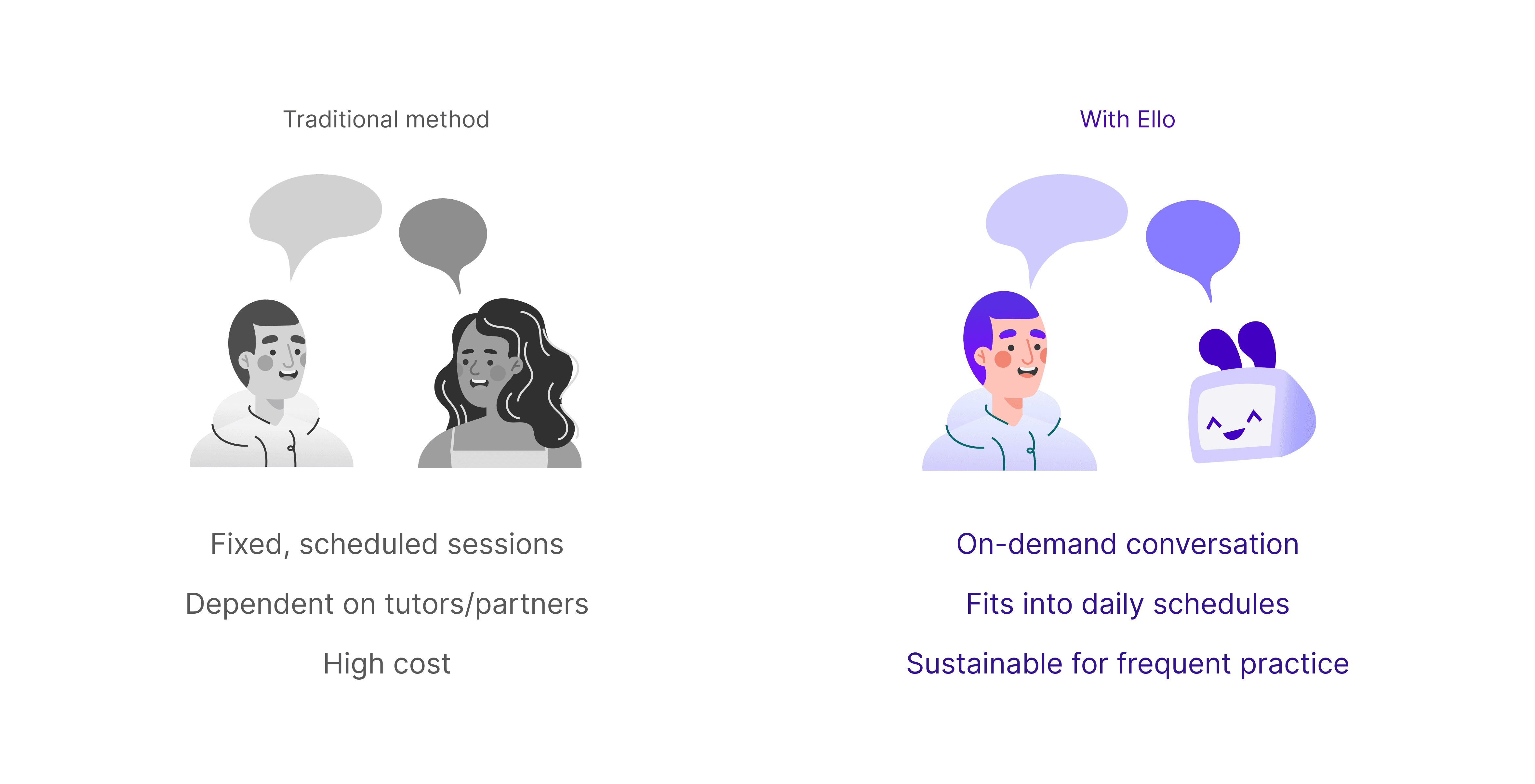
Designing conversation practice built for real-life schedules
Conversation practice often breaks down not because learners lack motivation, but because existing formats don’t align with how people actually find time to practice. Ello focused on making conversation easy to start and easy to repeat, so progress could come from consistency rather than intensity.
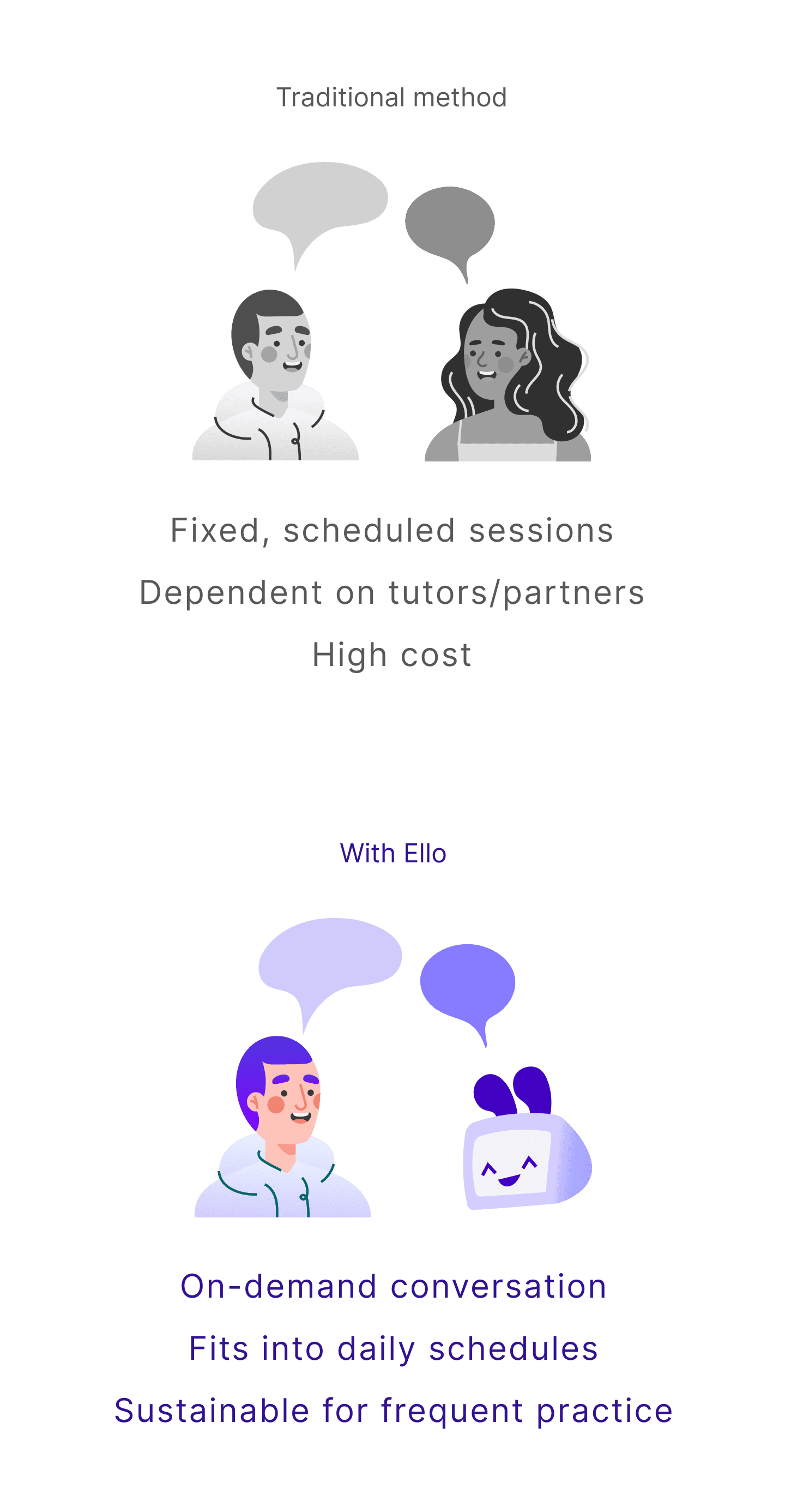
Designing conversation practice built for real-life schedules
Conversation practice often breaks down not because learners lack motivation, but because existing formats don’t align with how people actually find time to practice. Ello focused on making conversation easy to start and easy to repeat, so progress could come from consistency rather than intensity.
Designing conversation practice built for real-life schedules
Conversation practice often breaks down not because learners lack motivation, but because existing formats don’t align with how people actually find time to practice. Ello focused on making conversation easy to start and easy to repeat, so progress could come from consistency rather than intensity.
Designing conversation practice built for real-life schedules
Conversation practice often breaks down not because learners lack motivation, but because existing formats don’t align with how people actually find time to practice. Ello focused on making conversation easy to start and easy to repeat, so progress could come from consistency rather than intensity.
Designing conversation practice built for real-life schedules
Conversation practice often breaks down not because learners lack motivation, but because existing formats don’t align with how people actually find time to practice. Ello focused on making conversation easy to start and easy to repeat, so progress could come from consistency rather than intensity.
Product direction
Product direction
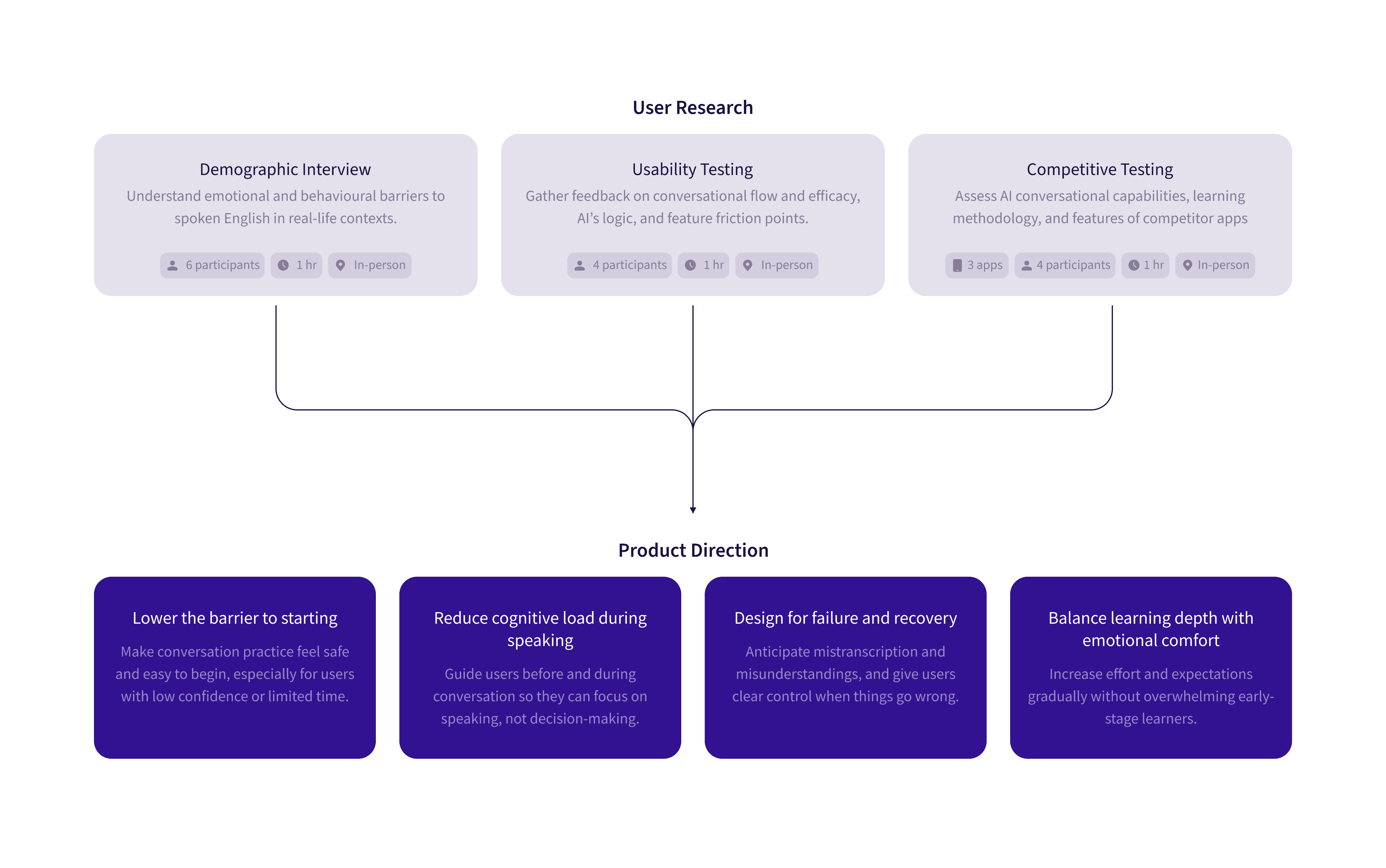
Creating a conversational experience that feels approachable, focused, and reliable
User research showed that users avoided open-ended conversation due to cognitive overload and fear of misunderstanding. Combined with early AI limitations, this shaped a direction toward focused, resilient, and low-pressure conversation practice.
Creating a conversational experience that feels approachable, focused, and reliable
User research showed that users avoided open-ended conversation due to cognitive overload and fear of misunderstanding. Combined with early AI limitations, this shaped a direction toward focused, resilient, and low-pressure conversation practice.
Creating a conversational experience that feels approachable, focused, and reliable
User research showed that users avoided open-ended conversation due to cognitive overload and fear of misunderstanding. Combined with early AI limitations, this shaped a direction toward focused, resilient, and low-pressure conversation practice.
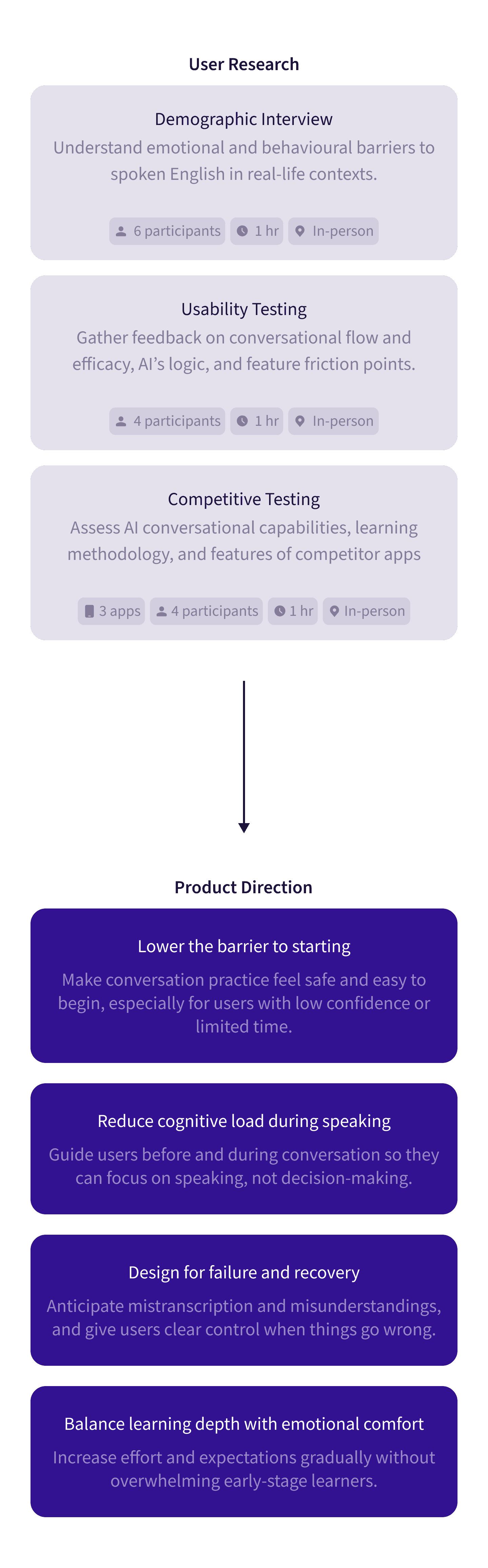
Creating a conversational experience that feels approachable, focused, and reliable
User research showed that users avoided open-ended conversation due to cognitive overload and fear of misunderstanding. Combined with early AI limitations, this shaped a direction toward focused, resilient, and low-pressure conversation practice.
App flows & features
App flows & features
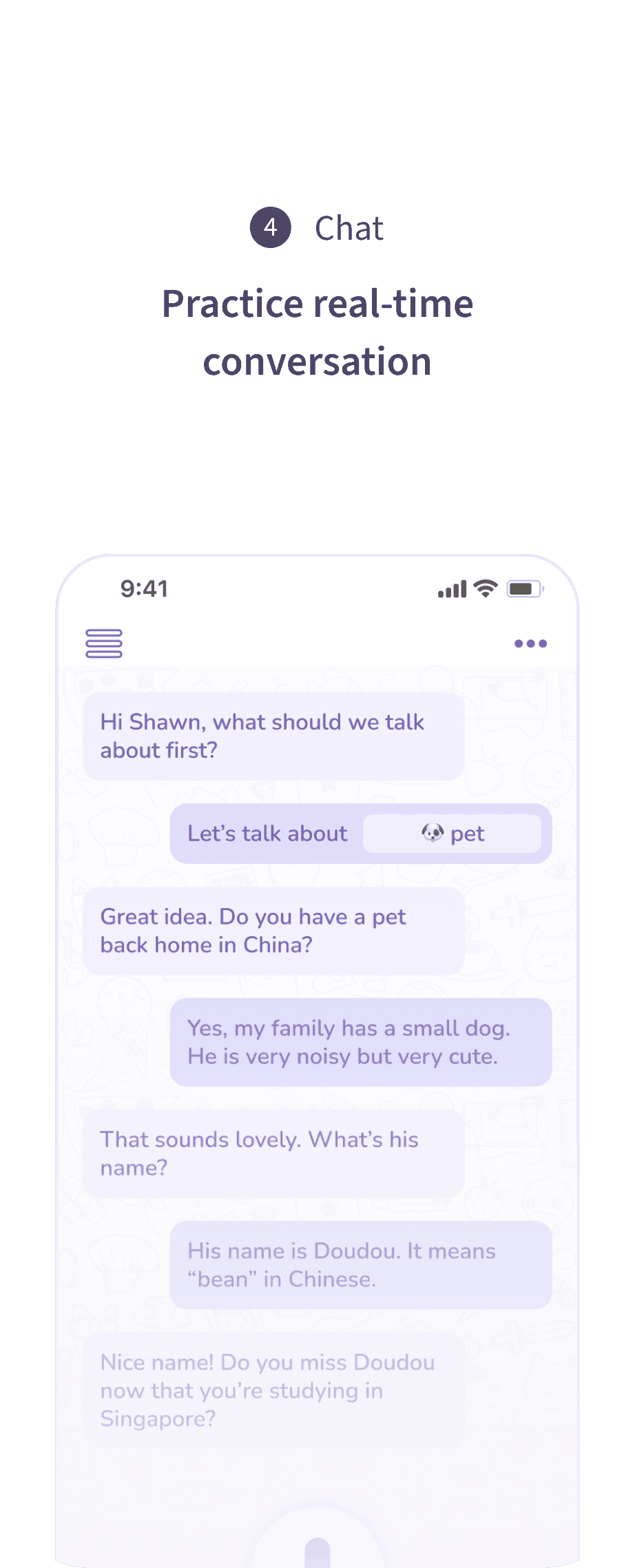
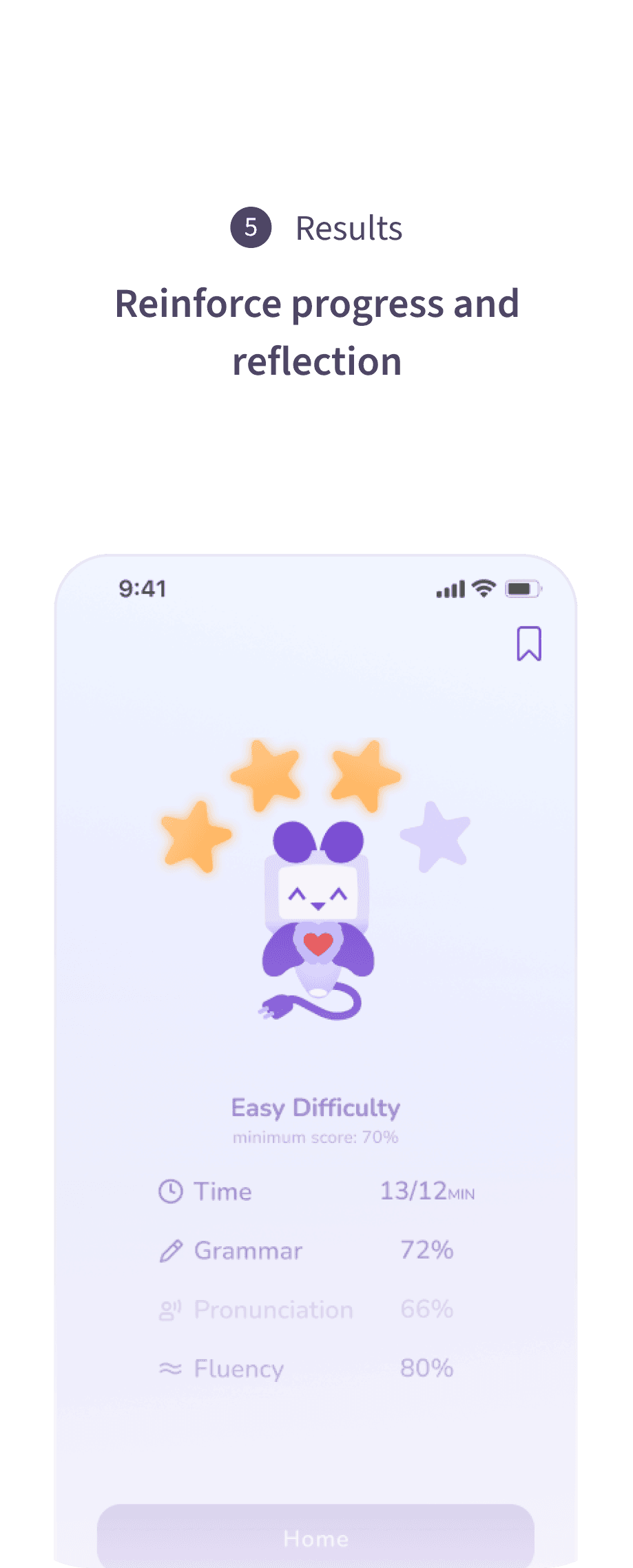
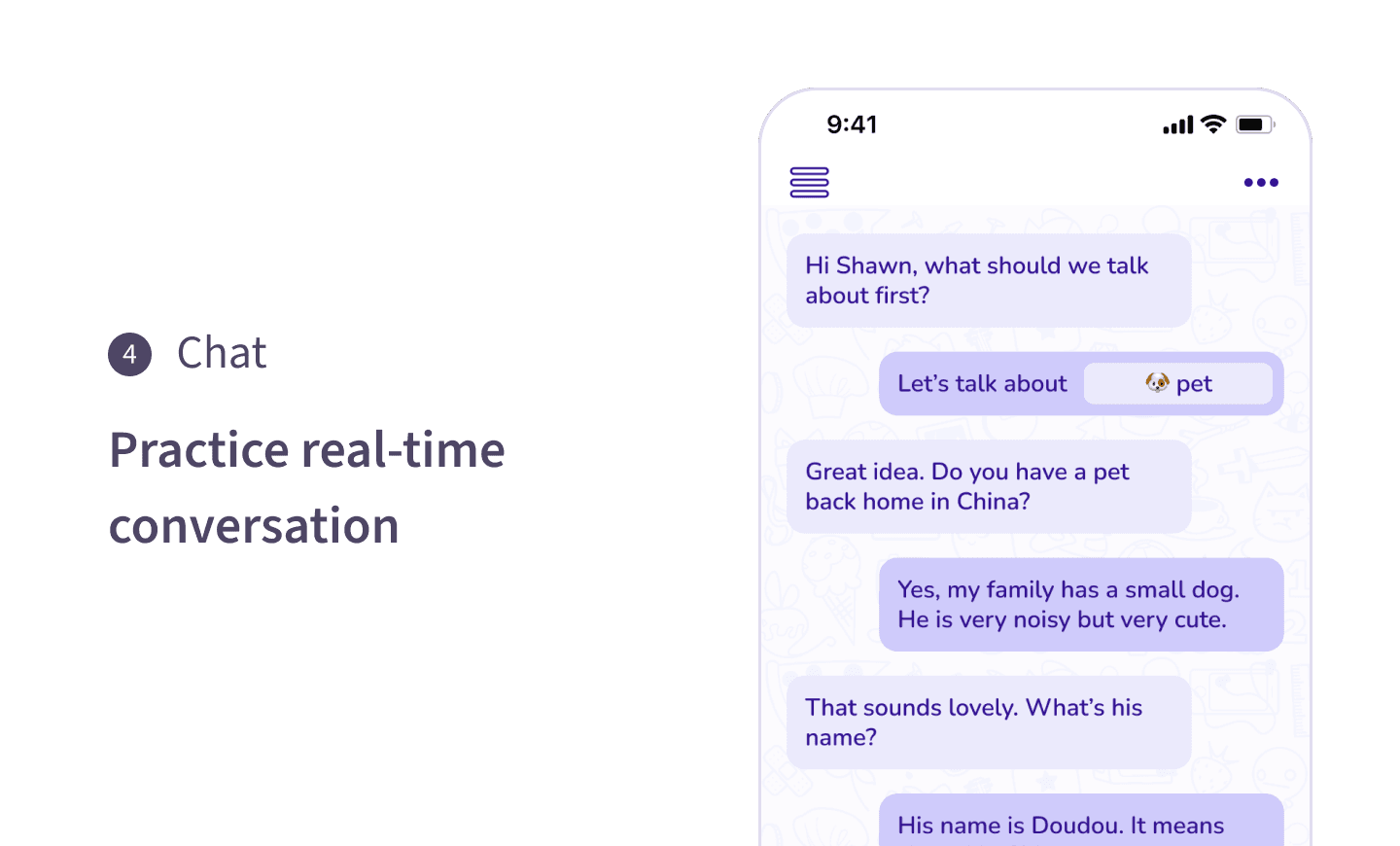
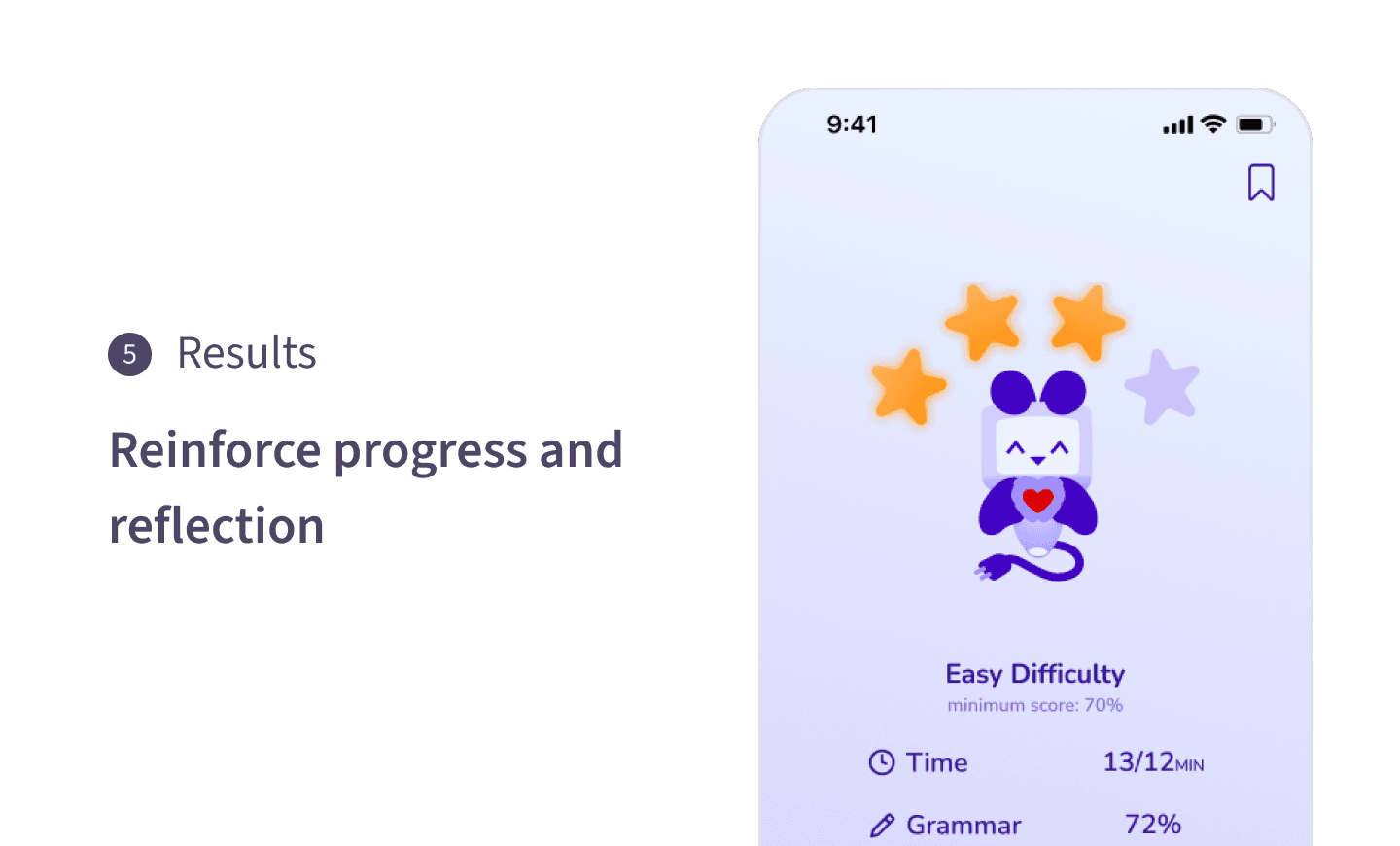
High-level conversation experience
High-level conversation experience
High-level conversation experience
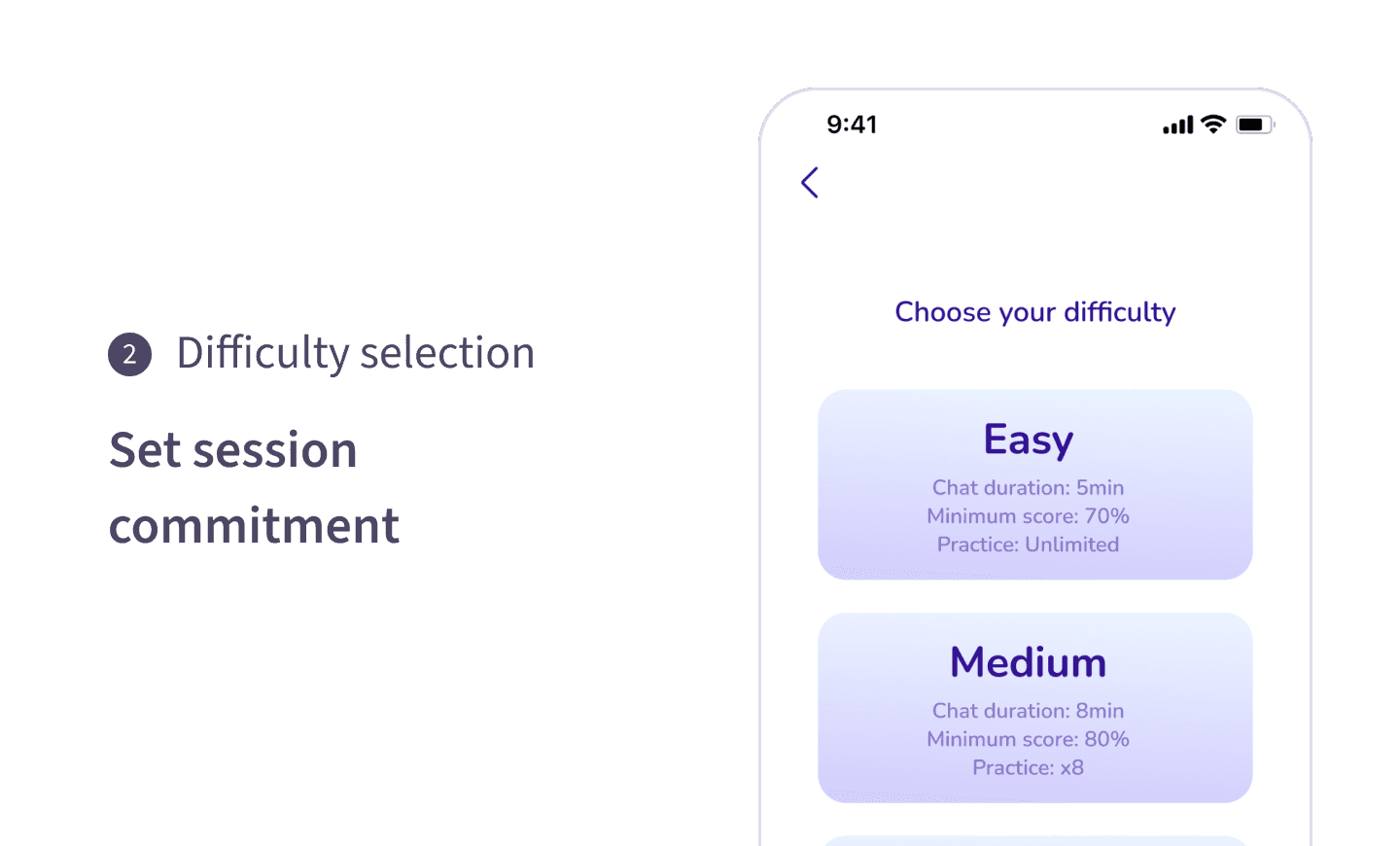
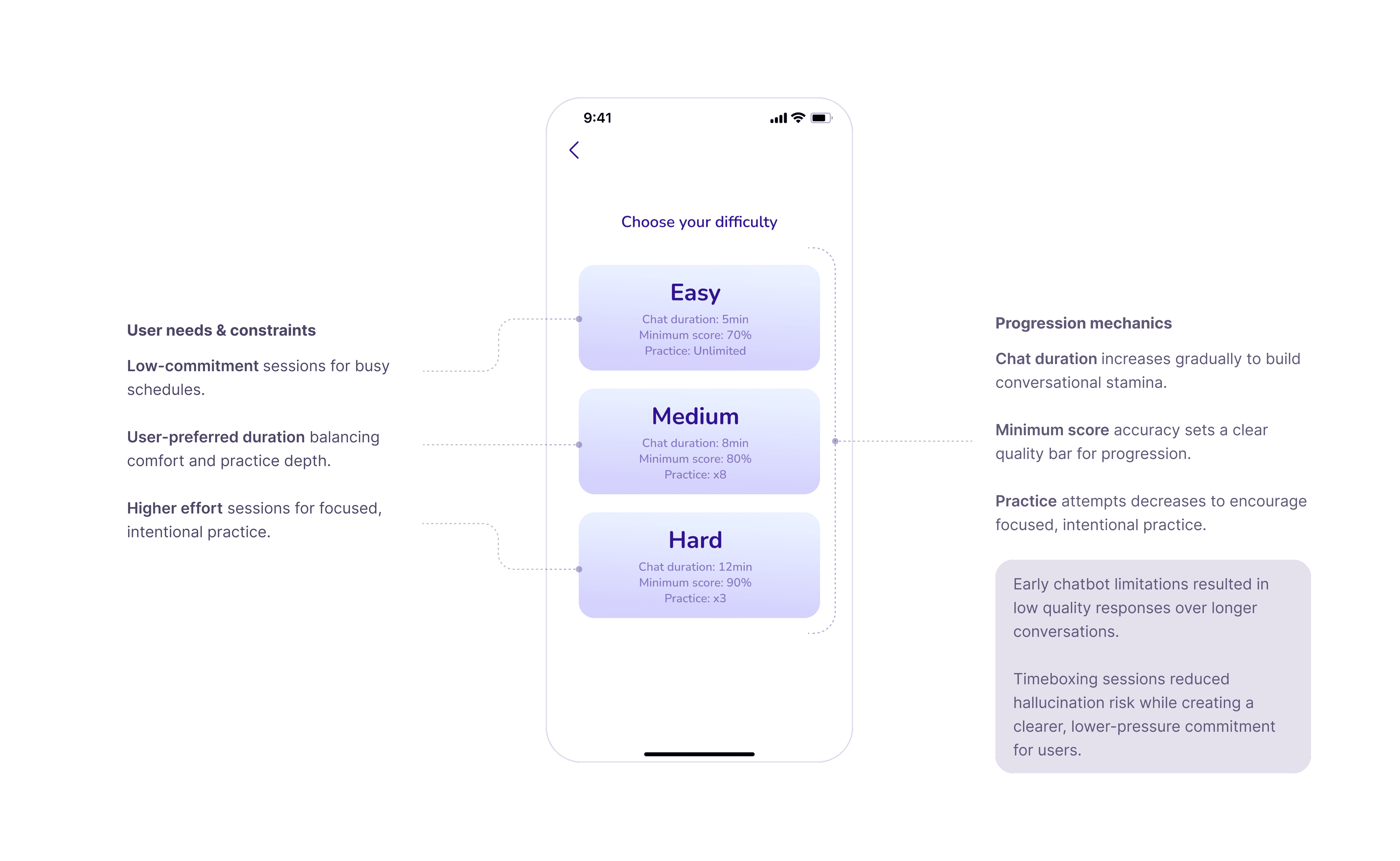
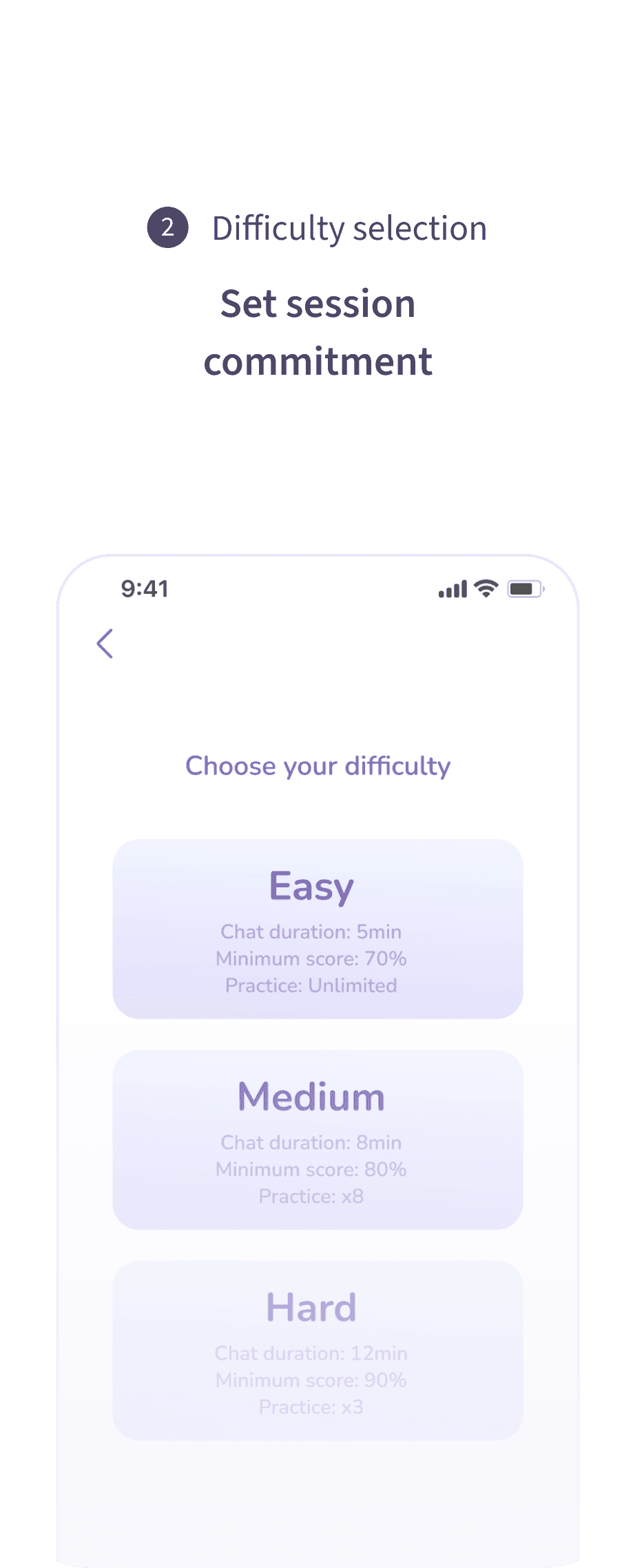
Difficulty framed as session commitment, not language ability
Instead of assessing skill, difficulty defined how much time, focus, and effort a session required. This allowed users to choose experiences that fit their availability while maintaining quality and reliability.
Difficulty framed as session commitment, not language ability
Instead of assessing skill, difficulty defined how much time, focus, and effort a session required. This allowed users to choose experiences that fit their availability while maintaining quality and reliability.
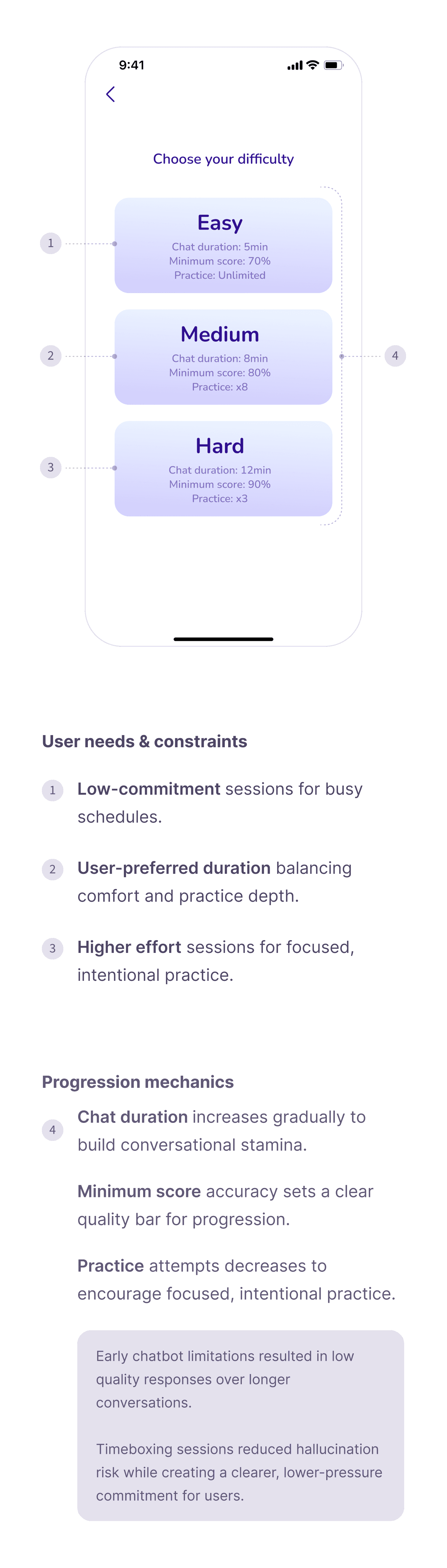
Difficulty framed as session commitment, not language ability
Instead of assessing skill, difficulty defined how much time, focus, and effort a session required. This allowed users to choose experiences that fit their availability while maintaining quality and reliability.
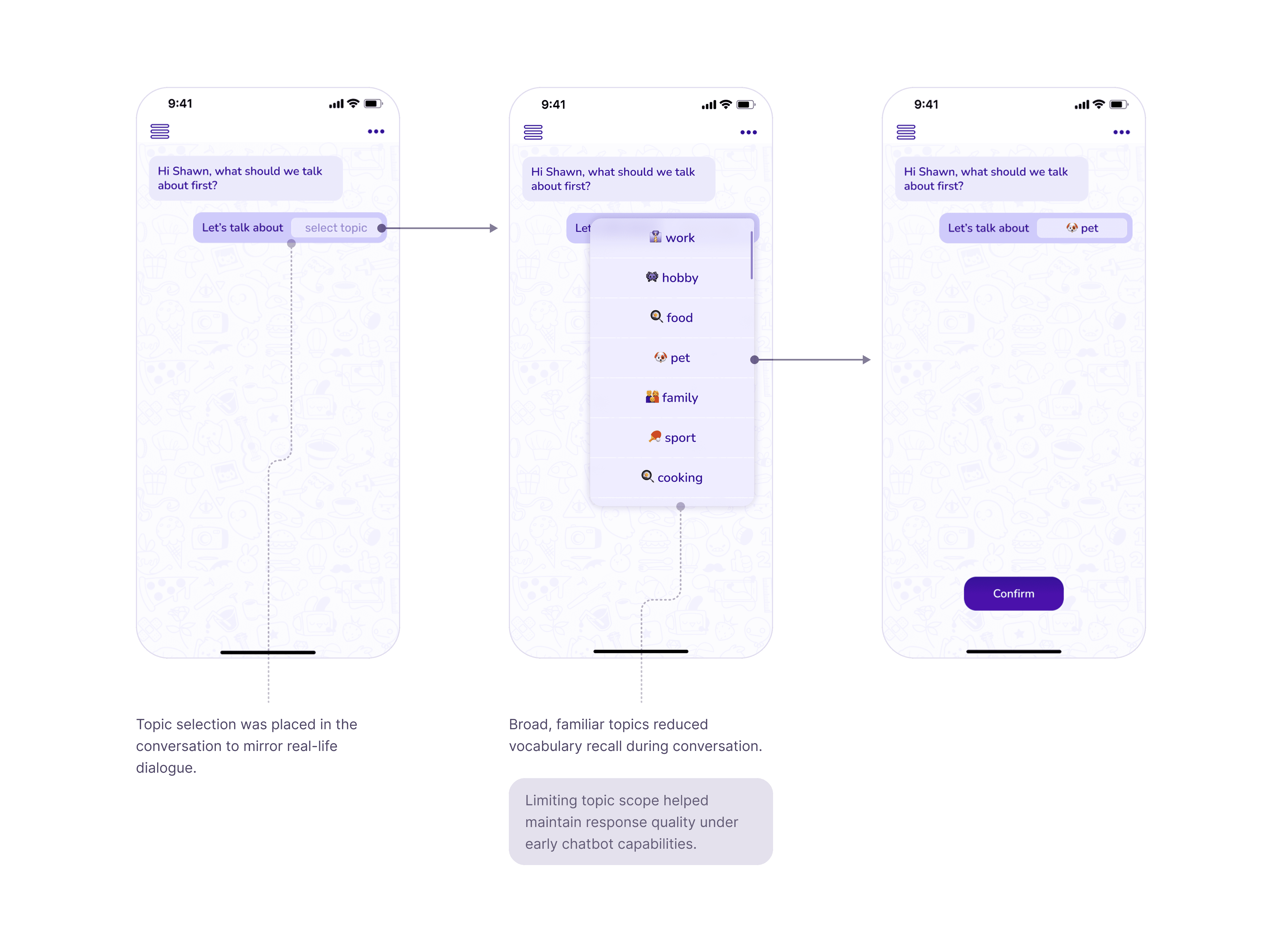
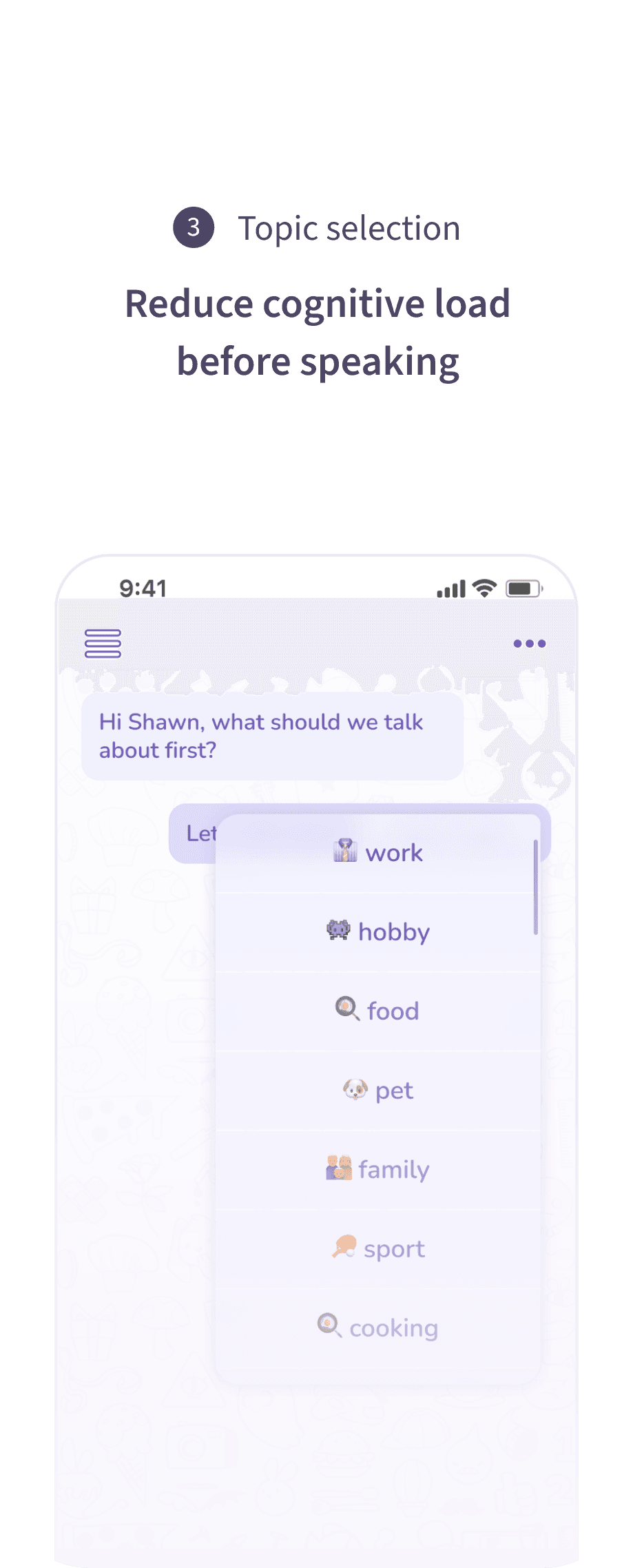
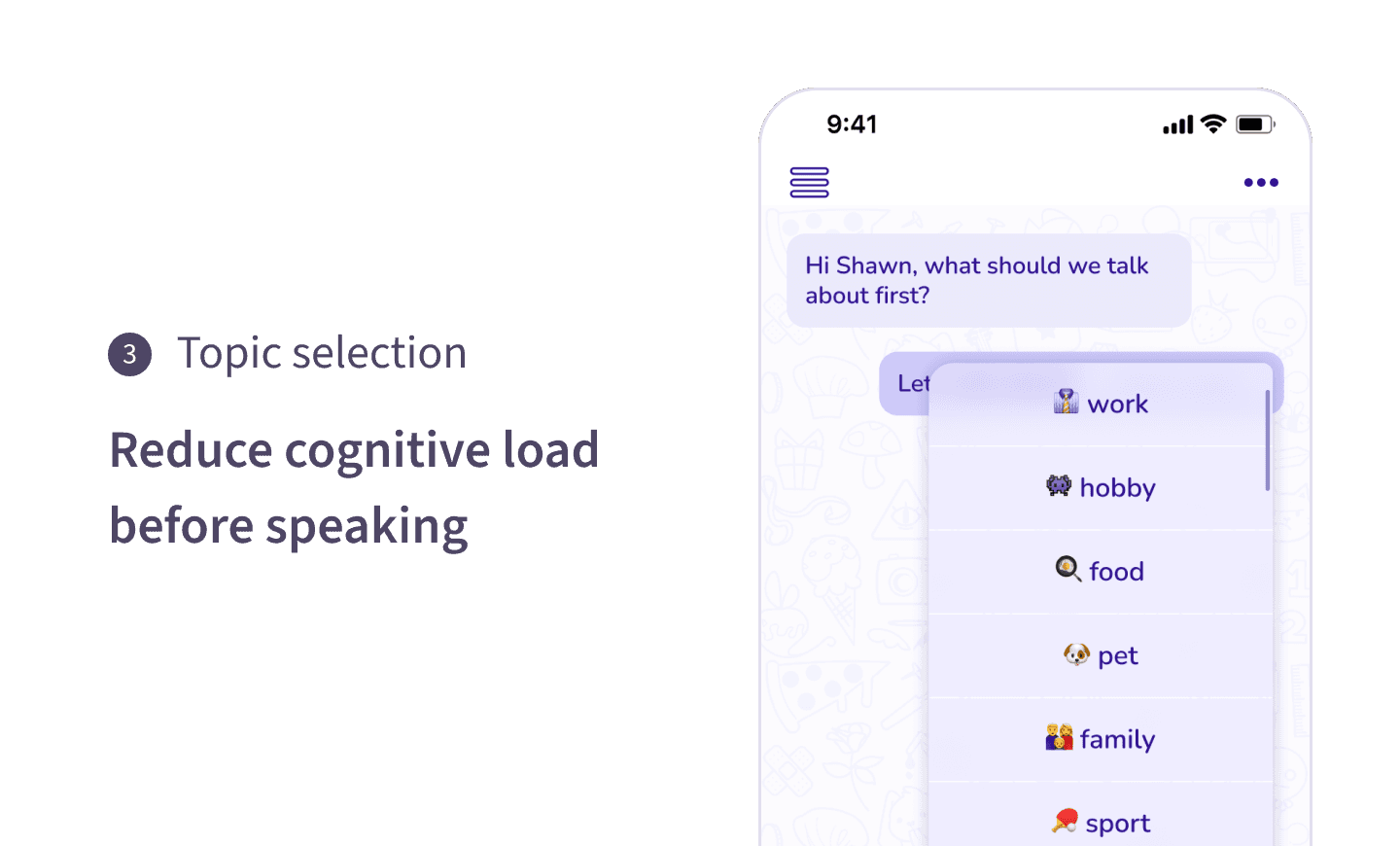
Predefined topics kept attention on speaking, not ideation
During conversations, users must recall vocabulary, structure sentences, and listen simultaneously. Providing a curated set of topics removed the additional burden of deciding what to talk about, allowing users to focus on speaking with confidence.

Predefined topics kept attention on speaking, not ideation
During conversations, users must recall vocabulary, structure sentences, and listen simultaneously. Providing a curated set of topics removed the additional burden of deciding what to talk about, allowing users to focus on speaking with confidence.
Predefined topics kept attention on speaking, not ideation
During conversations, users must recall vocabulary, structure sentences, and listen simultaneously. Providing a curated set of topics removed the additional burden of deciding what to talk about, allowing users to focus on speaking with confidence.
Predefined topics kept attention on speaking, not ideation
During conversations, users must recall vocabulary, structure sentences, and listen simultaneously. Providing a curated set of topics removed the additional burden of deciding what to talk about, allowing users to focus on speaking with confidence.
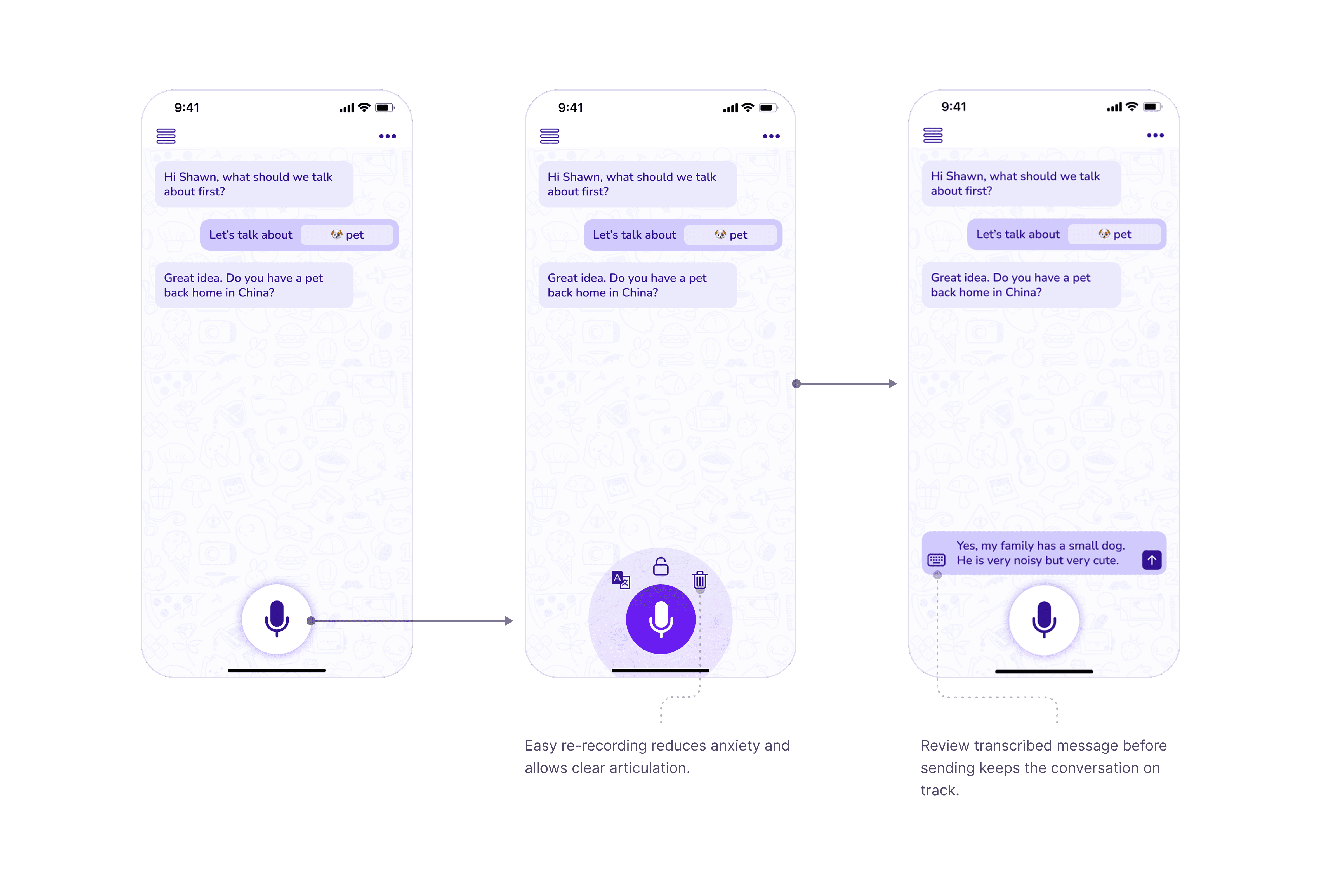
Giving users control before committing their spoken message
Because speaking a second language is emotionally risky, voice input was designed to support revision and recovery at multiple points. Commitment only happens once users feel confident in what they want to send.

Giving users control before committing their spoken message
Because speaking a second language is emotionally risky, voice input was designed to support revision and recovery at multiple points. Commitment only happens once users feel confident in what they want to send.
Giving users control before committing their spoken message
Because speaking a second language is emotionally risky, voice input was designed to support revision and recovery at multiple points. Commitment only happens once users feel confident in what they want to send.
Giving users control before committing their spoken message
Because speaking a second language is emotionally risky, voice input was designed to support revision and recovery at multiple points. Commitment only happens once users feel confident in what they want to send.
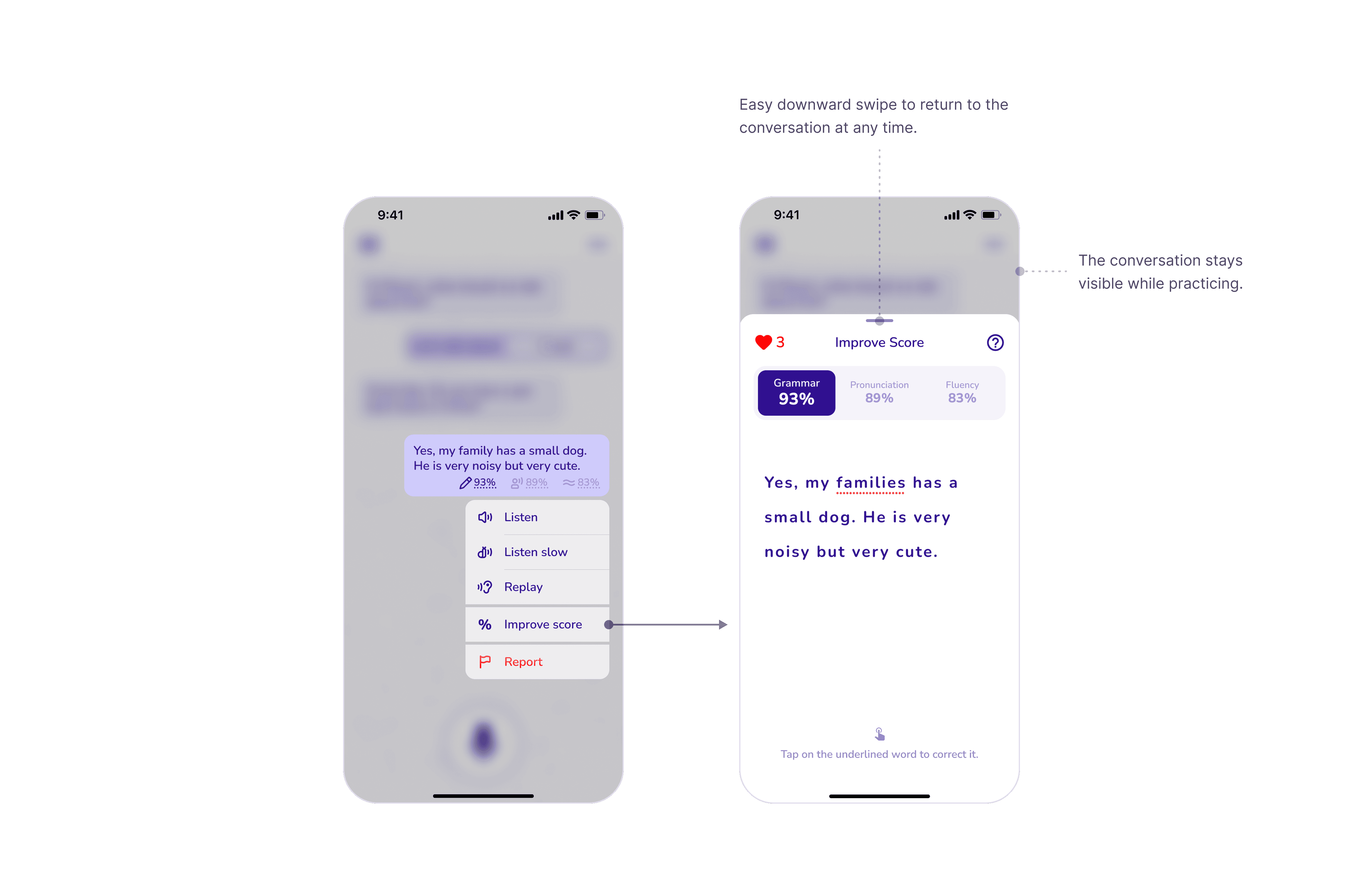
Allowing practice without pulling users out of the conversation
Grammar, pronunciation, and fluency practice appeared as a slide-up panel so users could improve without losing sight of the conversation. This made it easy to pause, practice, and return, without breaking the flow.
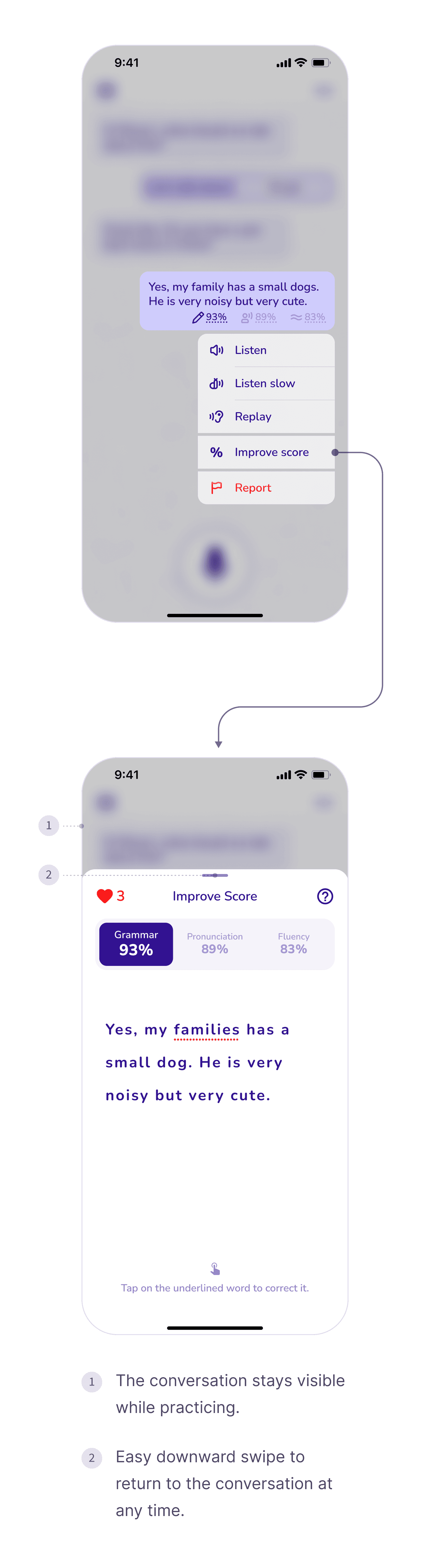
Allowing practice without pulling users out of the conversation
Grammar, pronunciation, and fluency practice appeared as a slide-up panel so users could improve without losing sight of the conversation. This made it easy to pause, practice, and return, without breaking the flow.
Allowing practice without pulling users out of the conversation
Grammar, pronunciation, and fluency practice appeared as a slide-up panel so users could improve without losing sight of the conversation. This made it easy to pause, practice, and return, without breaking the flow.
Allowing practice without pulling users out of the conversation
Grammar, pronunciation, and fluency practice appeared as a slide-up panel so users could improve without losing sight of the conversation. This made it easy to pause, practice, and return, without breaking the flow.
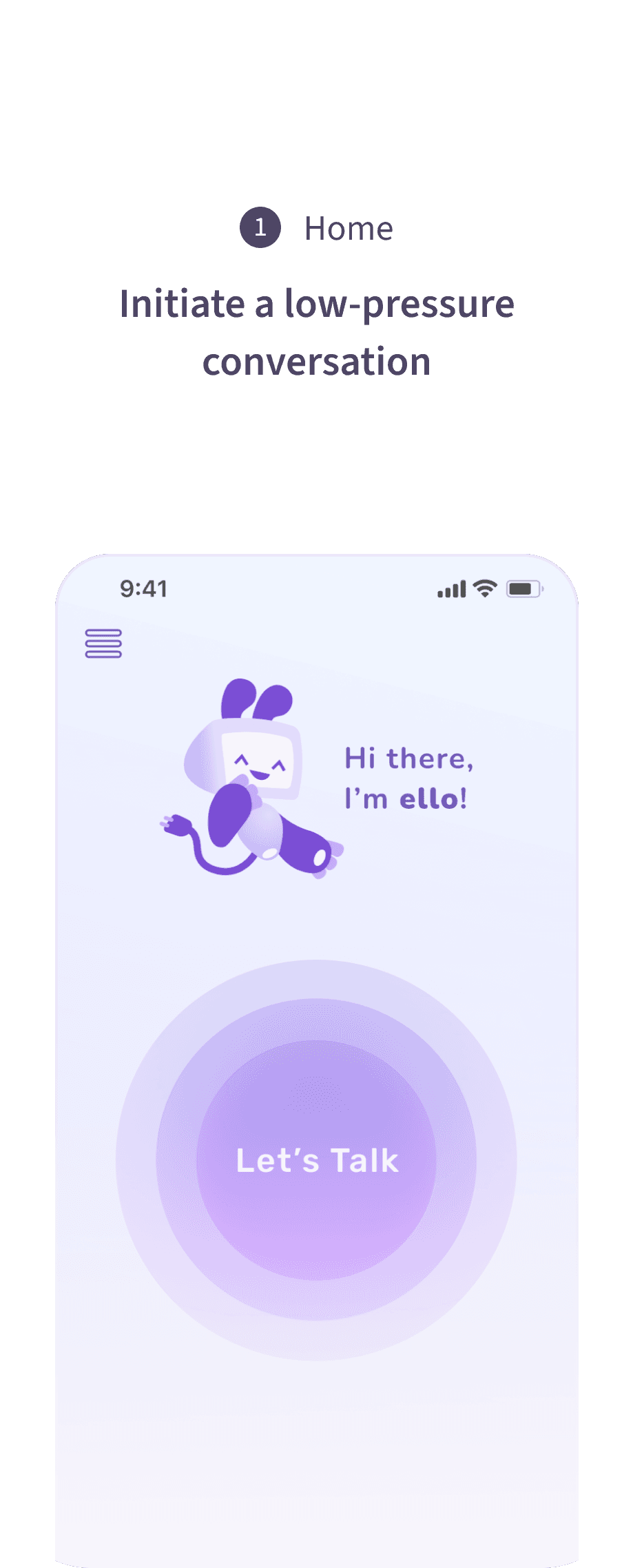
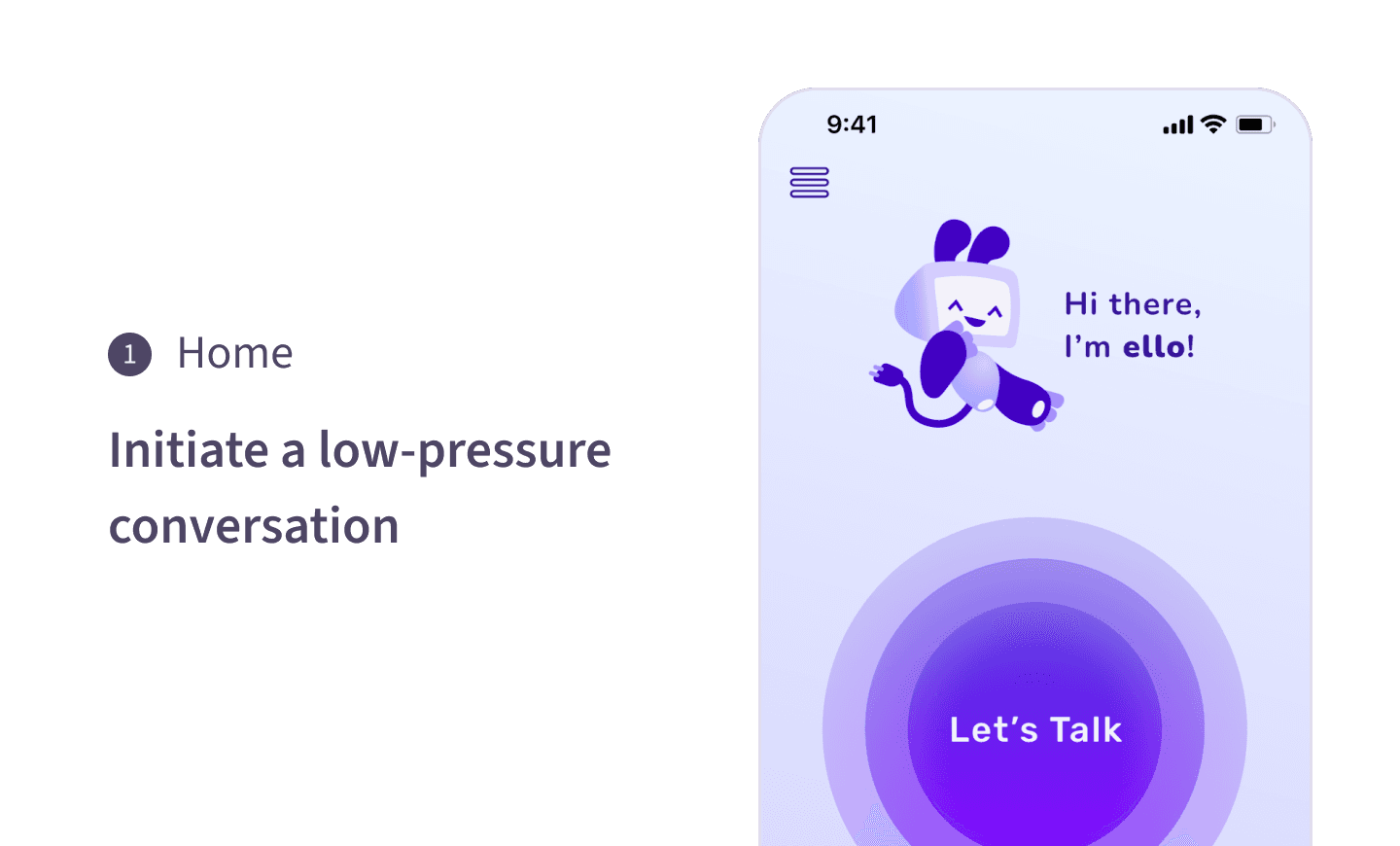
Lowering the emotional barrier to starting a conversation
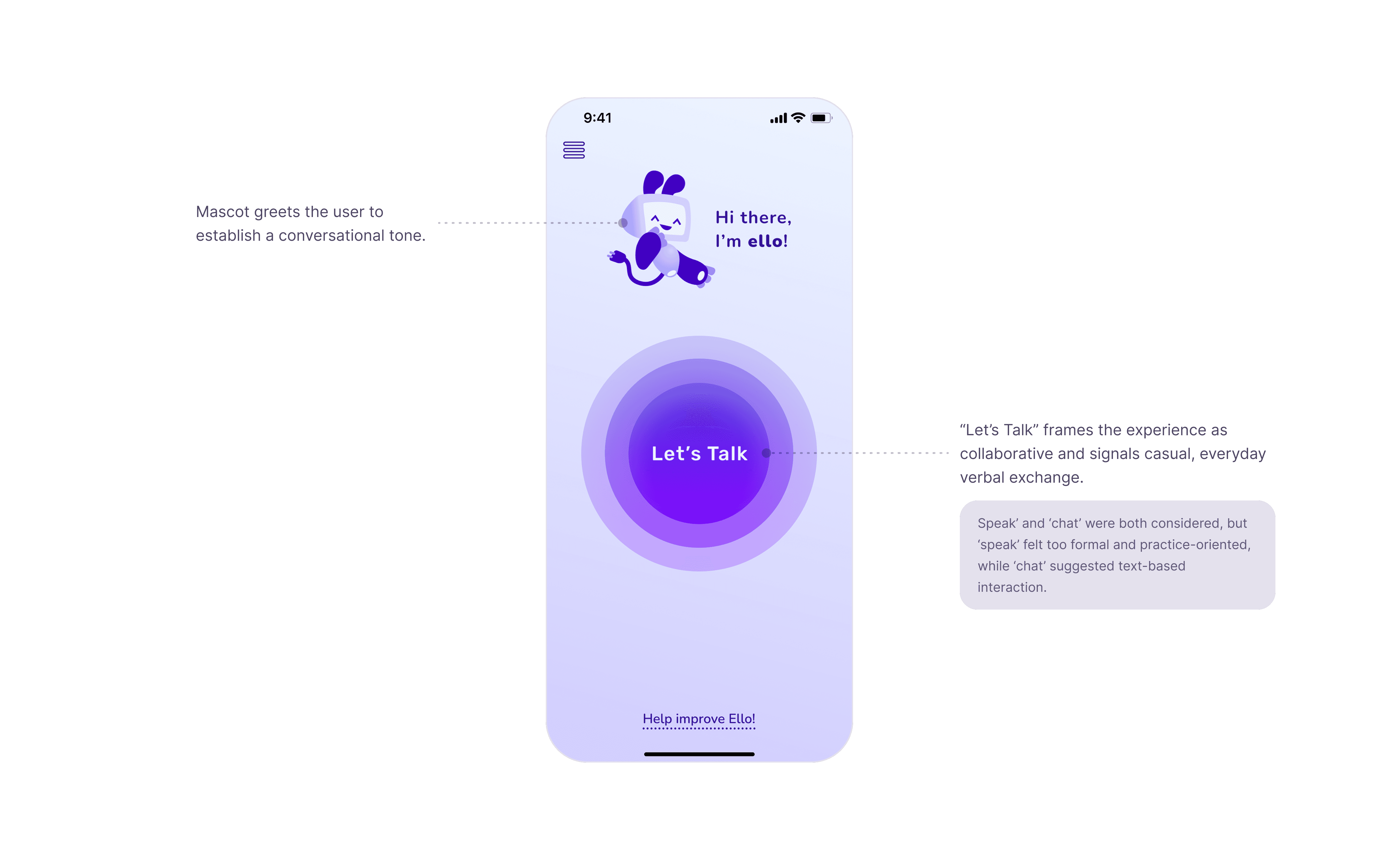
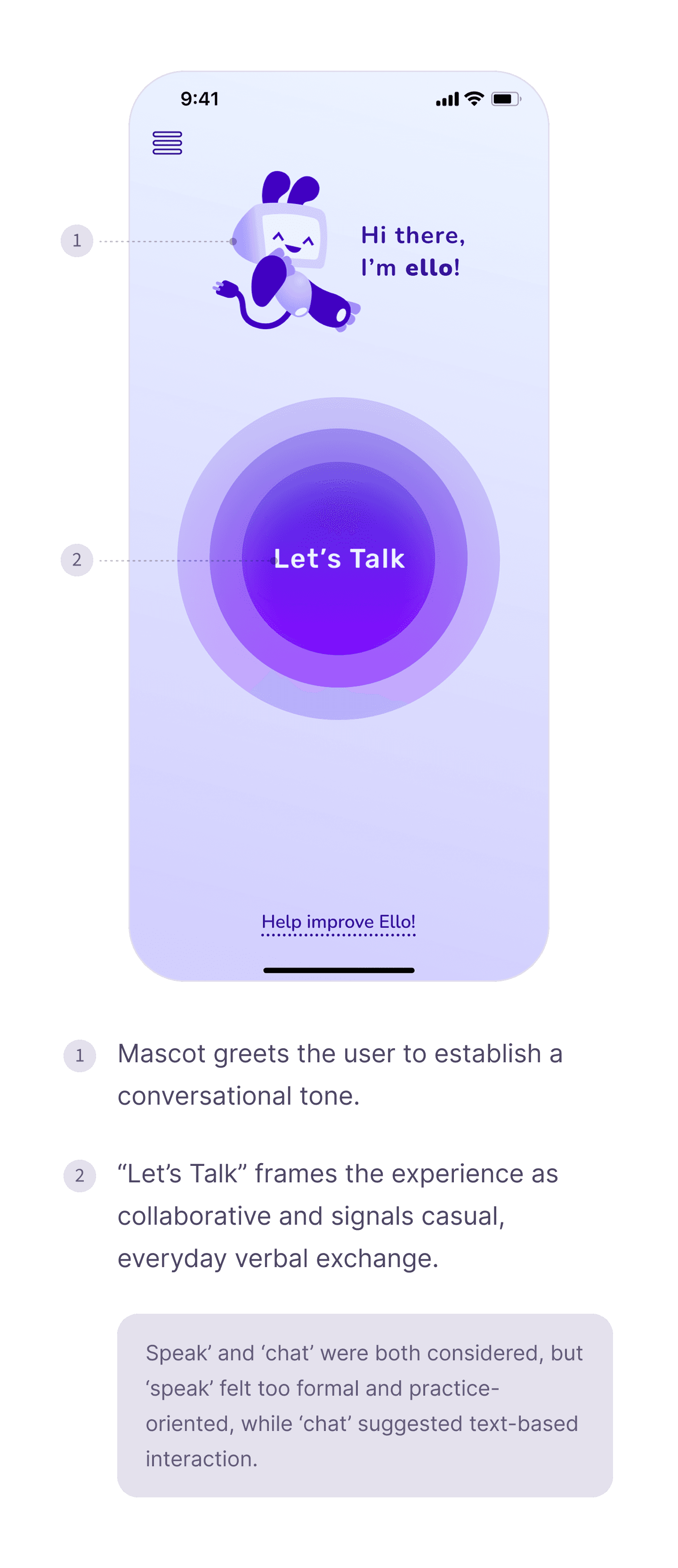
The home screen was designed to make starting feel casual rather than evaluative. By introducing the mascot as a conversational presence and using simple, inclusive language, the screen invites users to start a conversation without setup, explanation, or pressure.
Lowering the emotional barrier to starting a conversation
The home screen was designed to make starting feel casual rather than evaluative. By introducing the mascot as a conversational presence and using simple, inclusive language, the screen invites users to start a conversation without setup, explanation, or pressure.
Lowering the emotional barrier to starting a conversation
The home screen was designed to make starting feel casual rather than evaluative. By introducing the mascot as a conversational presence and using simple, inclusive language, the screen invites users to start a conversation without setup, explanation, or pressure.
Lowering the emotional barrier to starting a conversation
The home screen was designed to make starting feel casual rather than evaluative. By introducing the mascot as a conversational presence and using simple, inclusive language, the screen invites users to start a conversation without setup, explanation, or pressure.
Lowering the emotional barrier to starting a conversation
The home screen was designed to make starting feel casual rather than evaluative. By introducing the mascot as a conversational presence and using simple, inclusive language, the screen invites users to start a conversation without setup, explanation, or pressure.
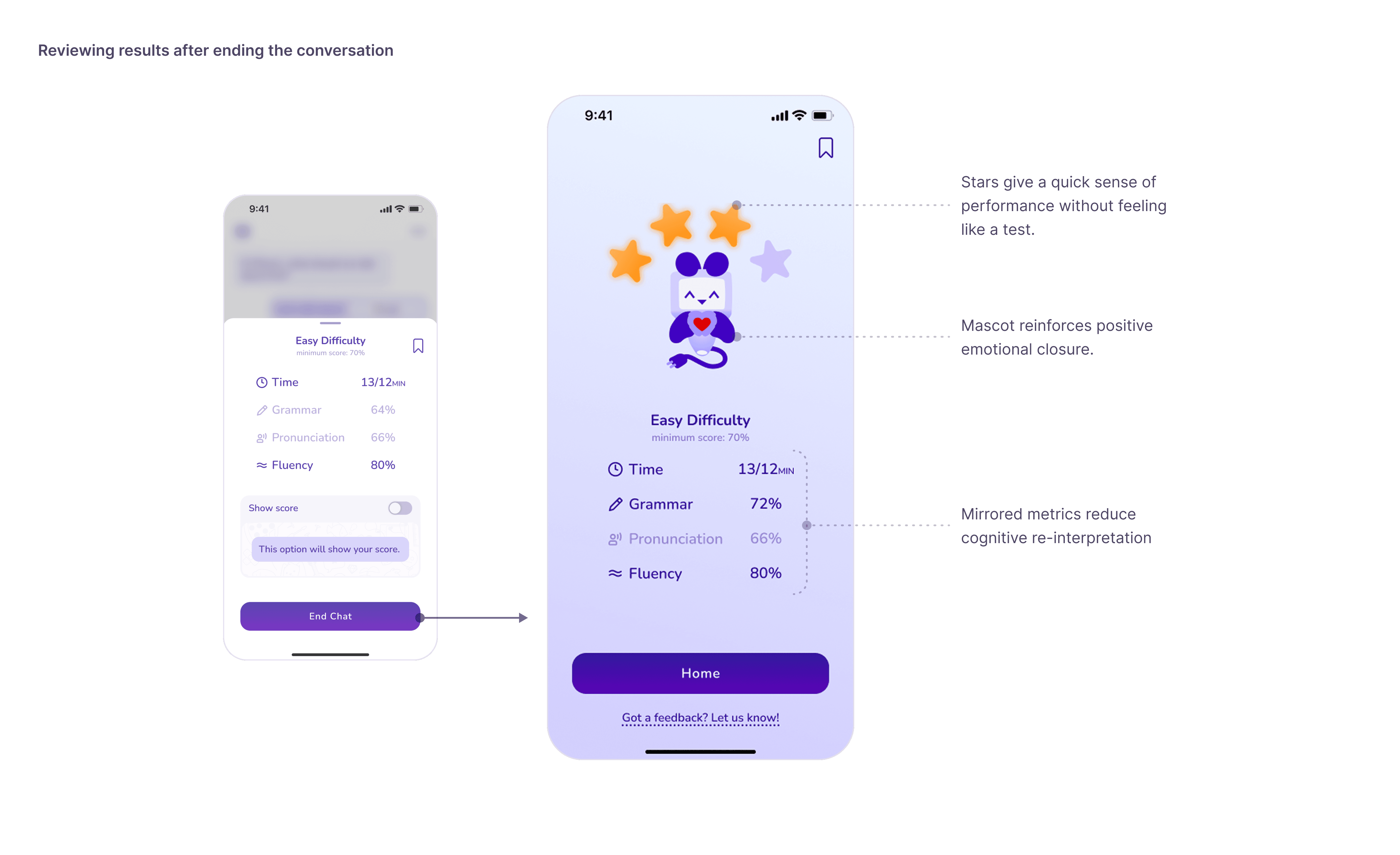
Designing feedback as something users opt into
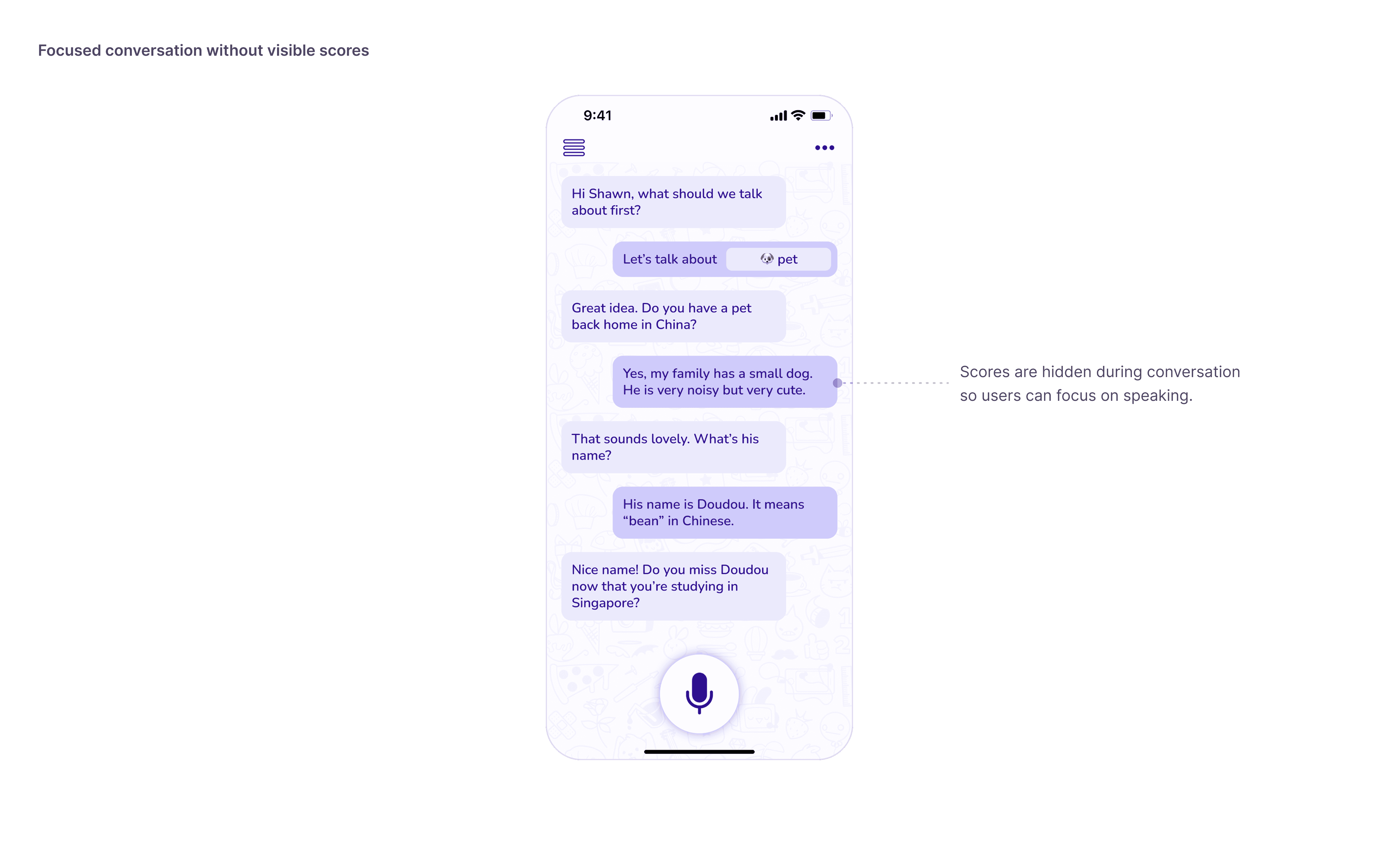
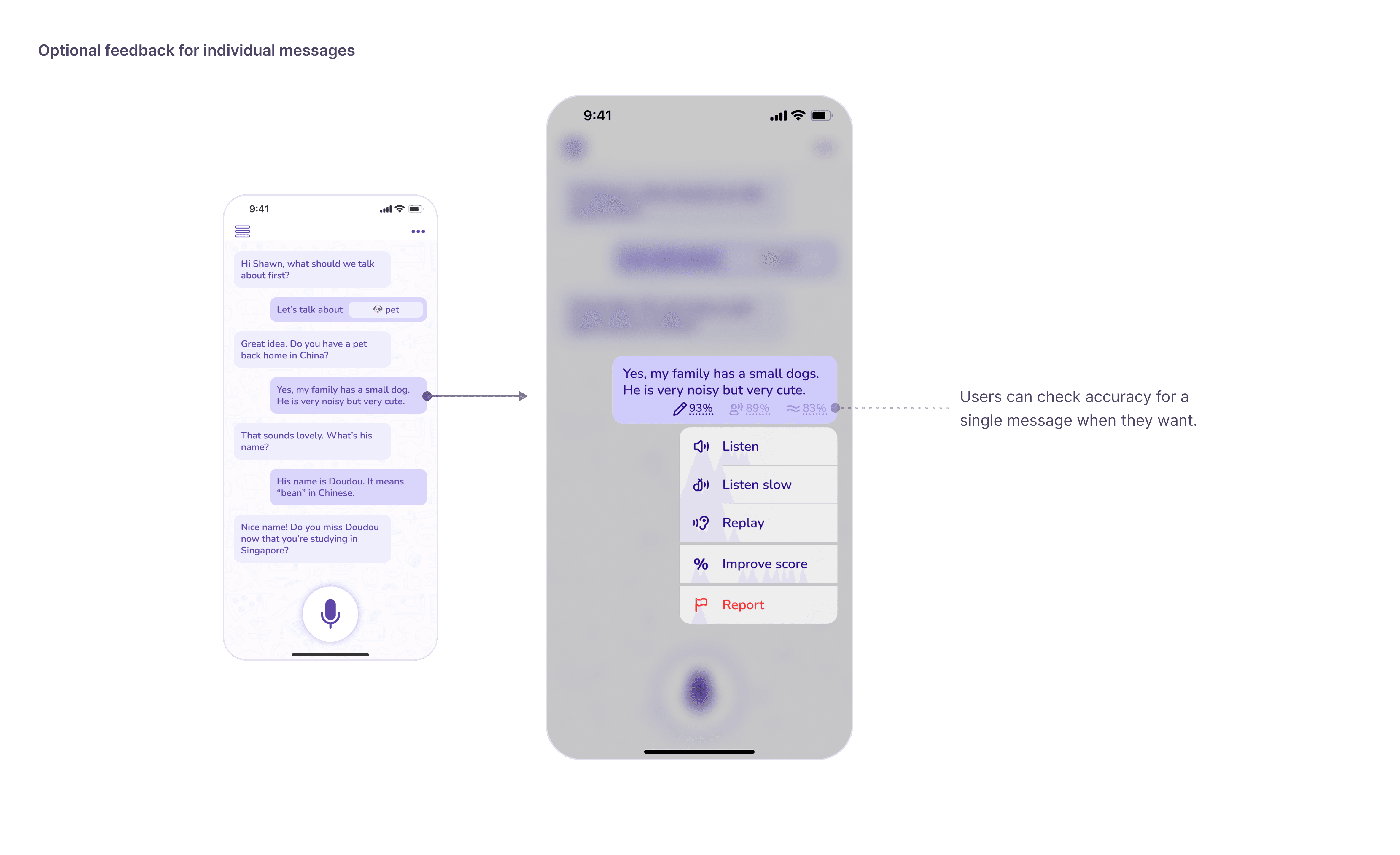
Performance feedback was designed to be optional during conversation and reflective after completion. This allowed users to stay focused by default, while giving motivated learners control over when and how they engaged with scores.
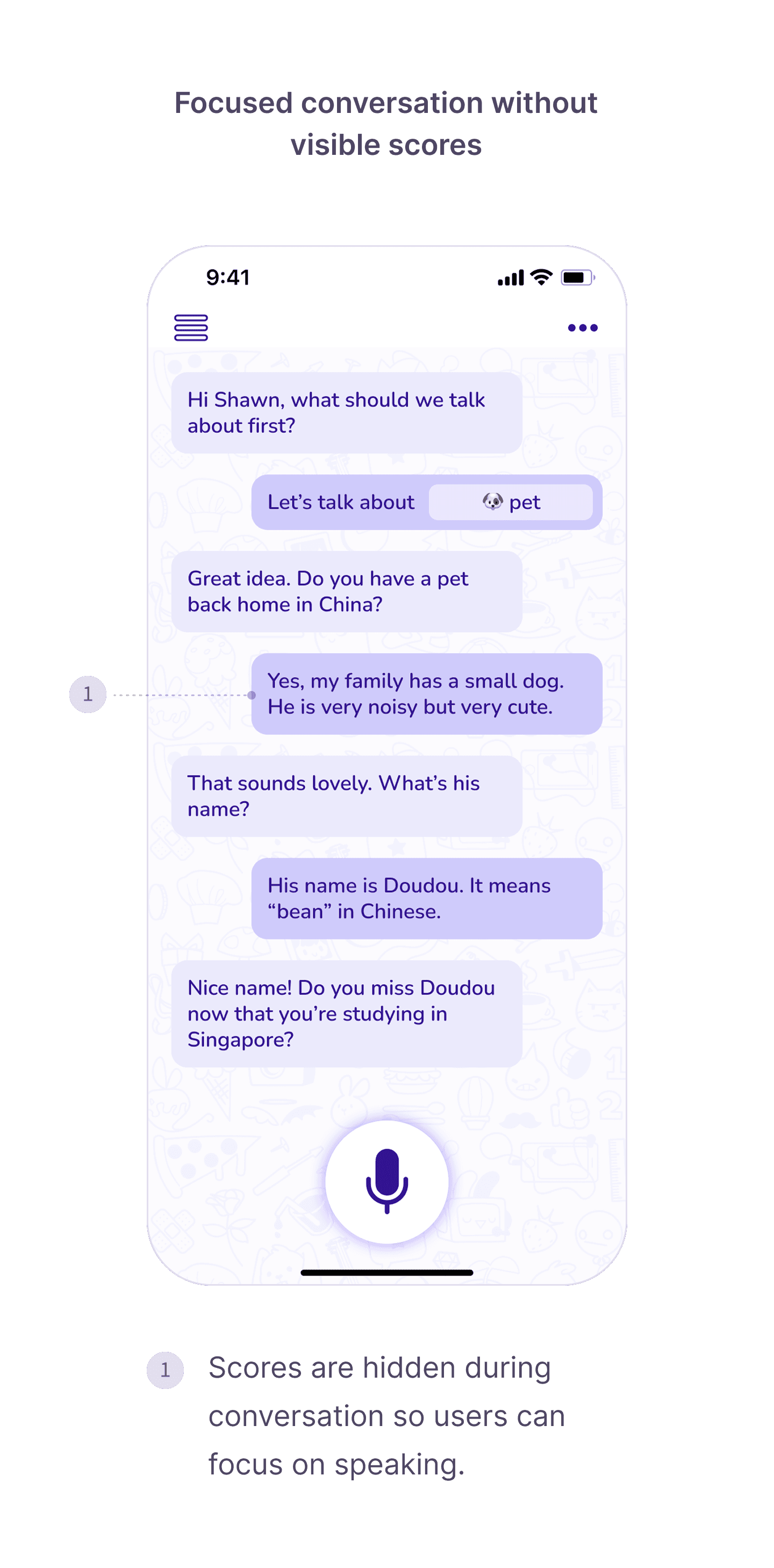
Designing feedback as something users opt into
Performance feedback was designed to be optional during conversation and reflective after completion. This allowed users to stay focused by default, while giving motivated learners control over when and how they engaged with scores.
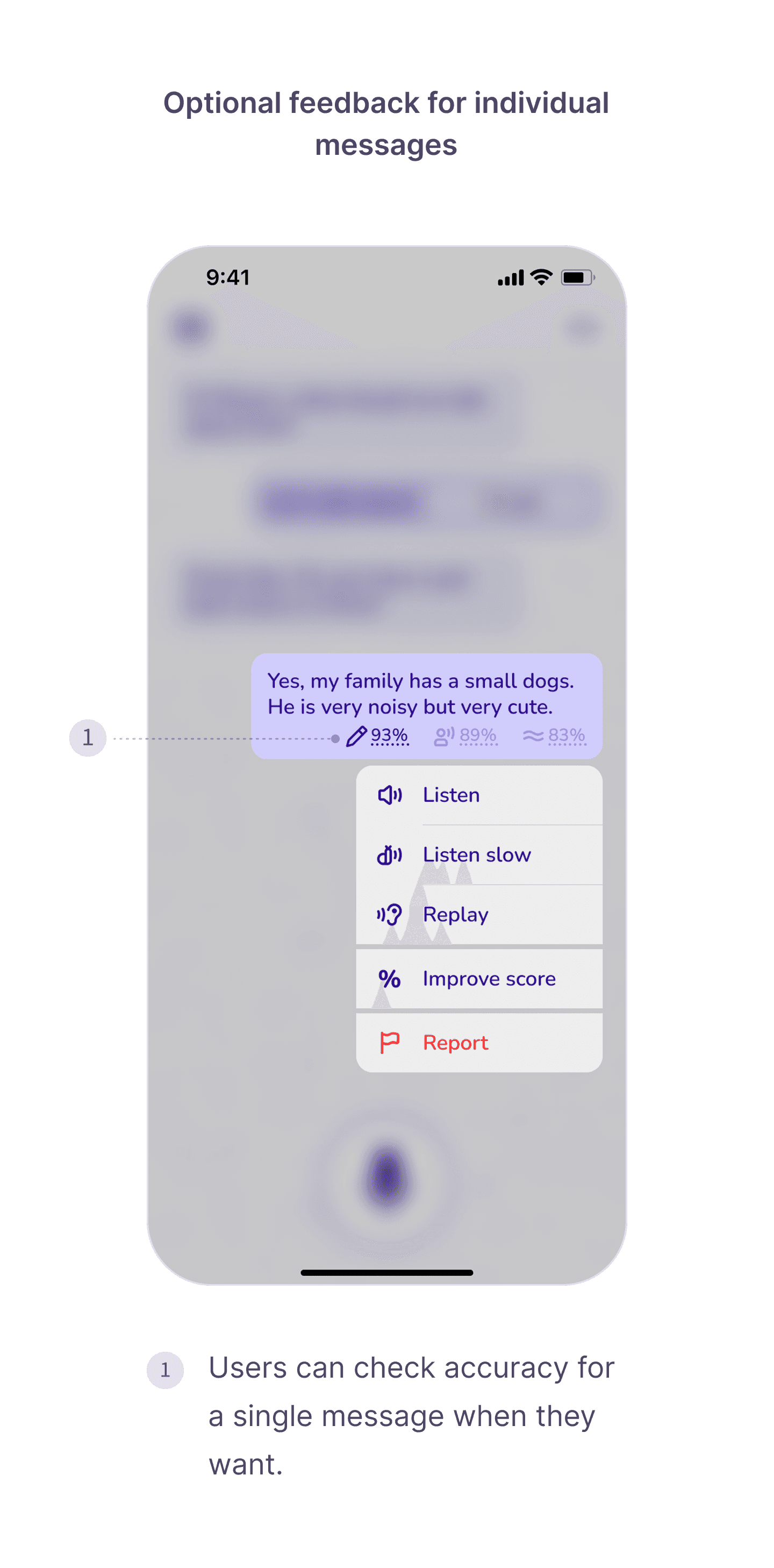
Designing feedback as something users opt into
Performance feedback was designed to be optional during conversation and reflective after completion. This allowed users to stay focused by default, while giving motivated learners control over when and how they engaged with scores.
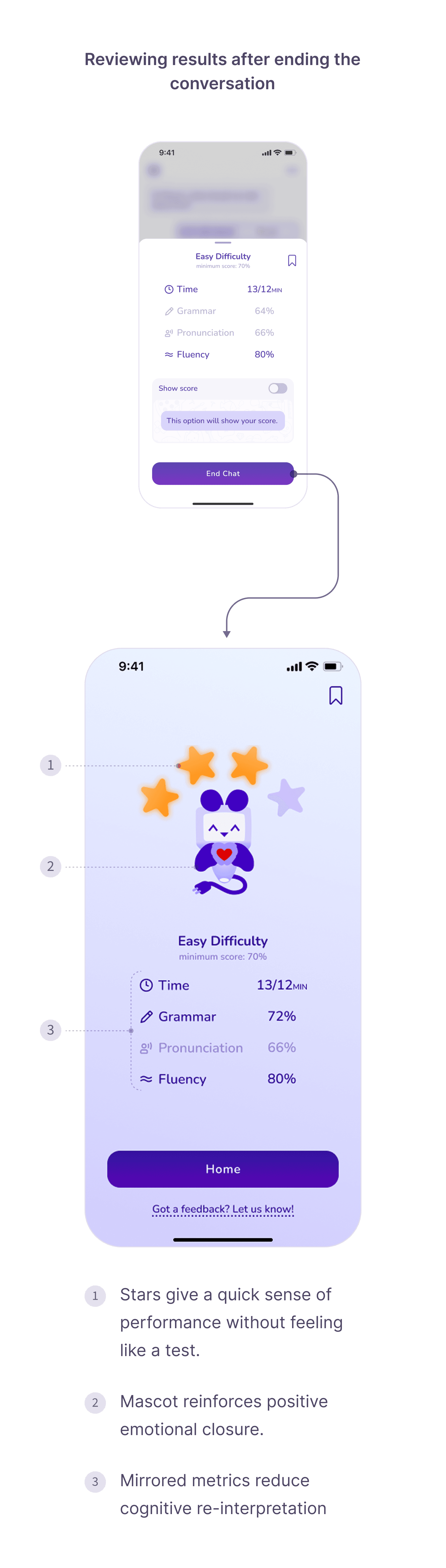
Designing feedback as something users opt into
Performance feedback was designed to be optional during conversation and reflective after completion. This allowed users to stay focused by default, while giving motivated learners control over when and how they engaged with scores.

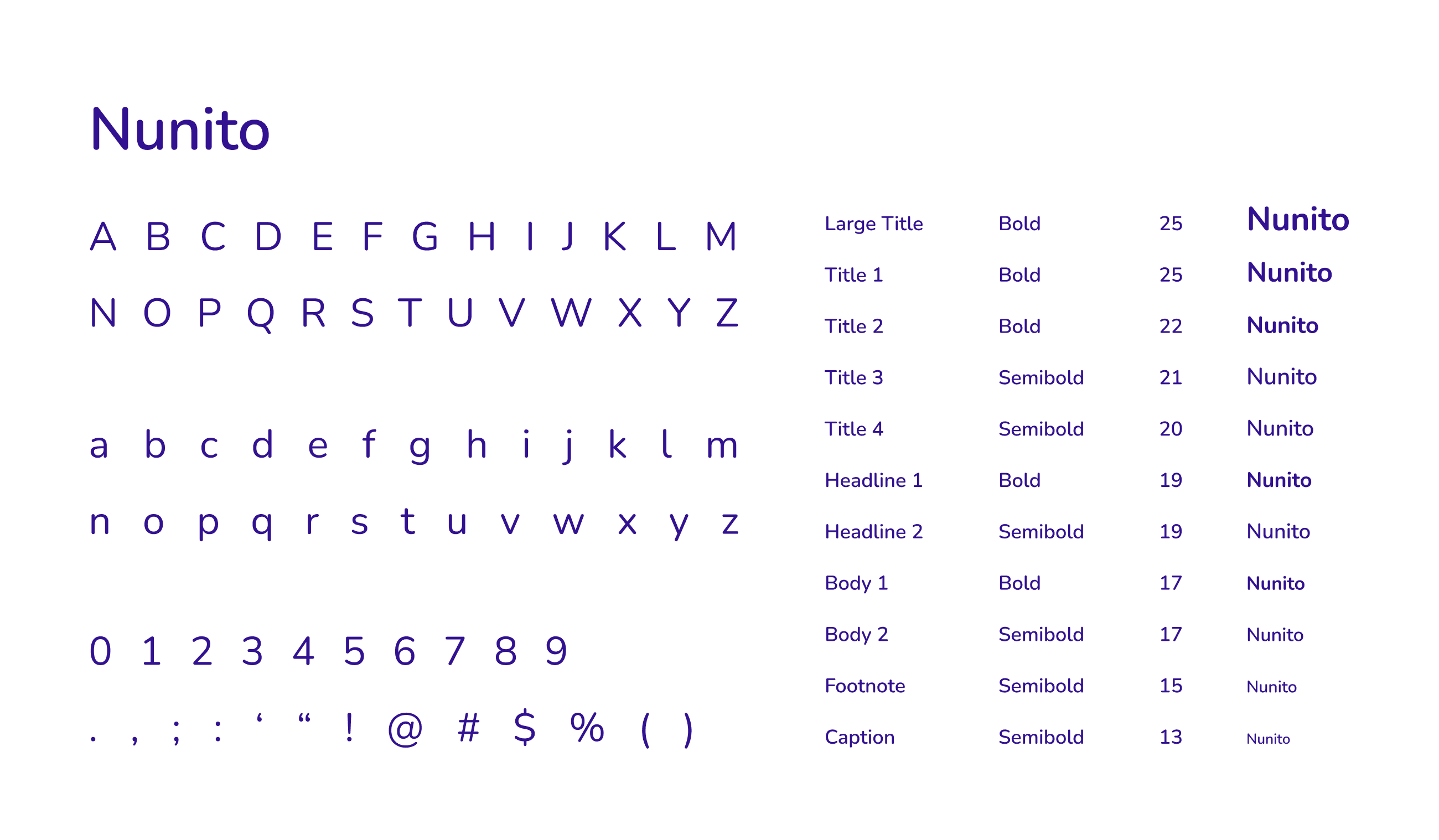
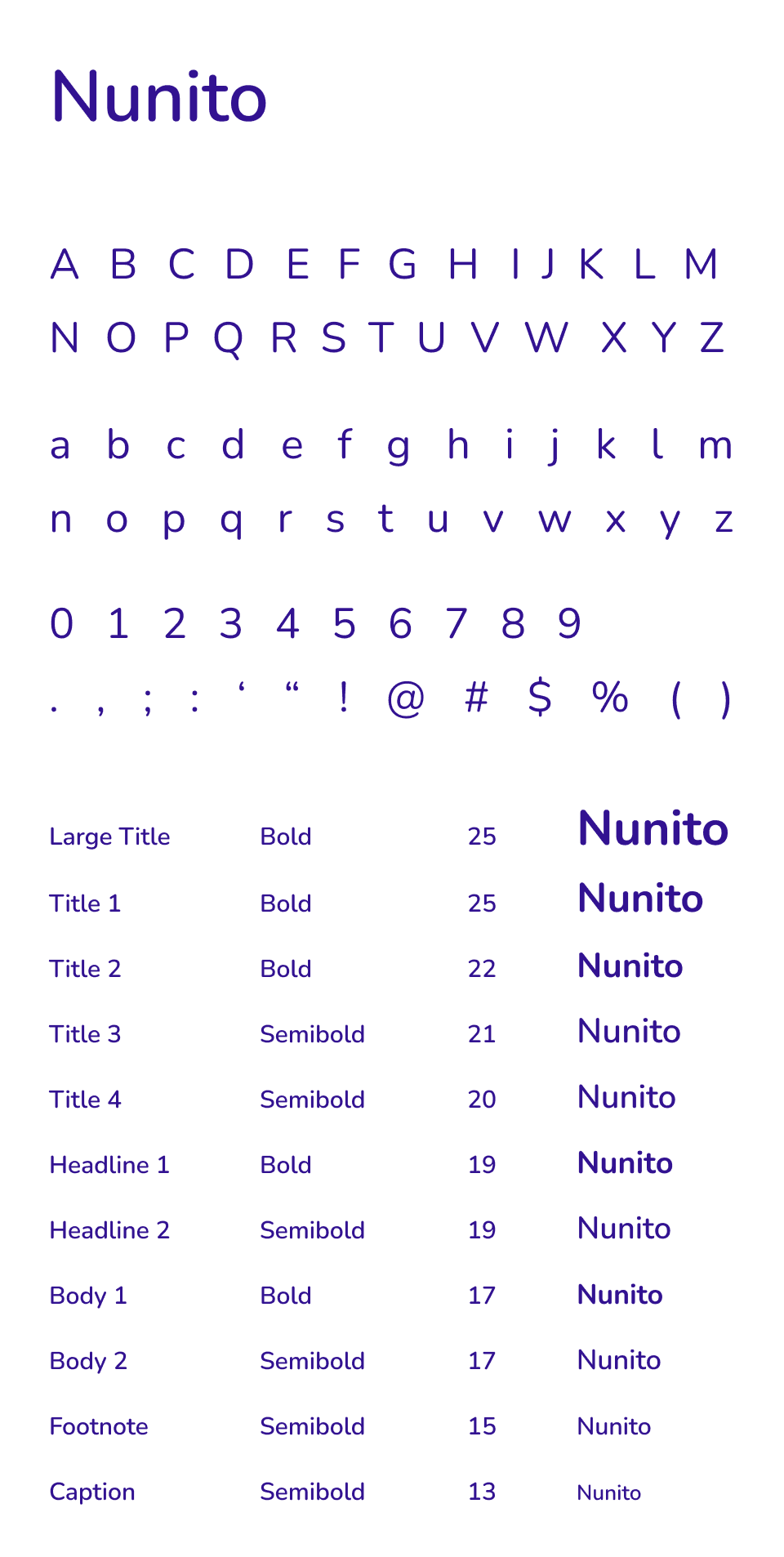
Design system
Design system
#F4F2FA
#321291
#9888C8

#2F18A0
#5B02B5

#5034DF
#8105FF

#EBF3FF
#D2CFFD
Quick view of conversation scores
#F4F2FA
#F4F2FA
#321291
#9888C8
#2F18A0
#5B02B5
#5034DF
#8105FF
#EBF3FF
#D2CFFD
Quick view of conversation scores
#F4F2FA
Quick view of conversation scores
#F4F2FA

Proficiency scores for serious learners
Proficiency scores for serious learners
View other works
3D Maze
Edu-tech
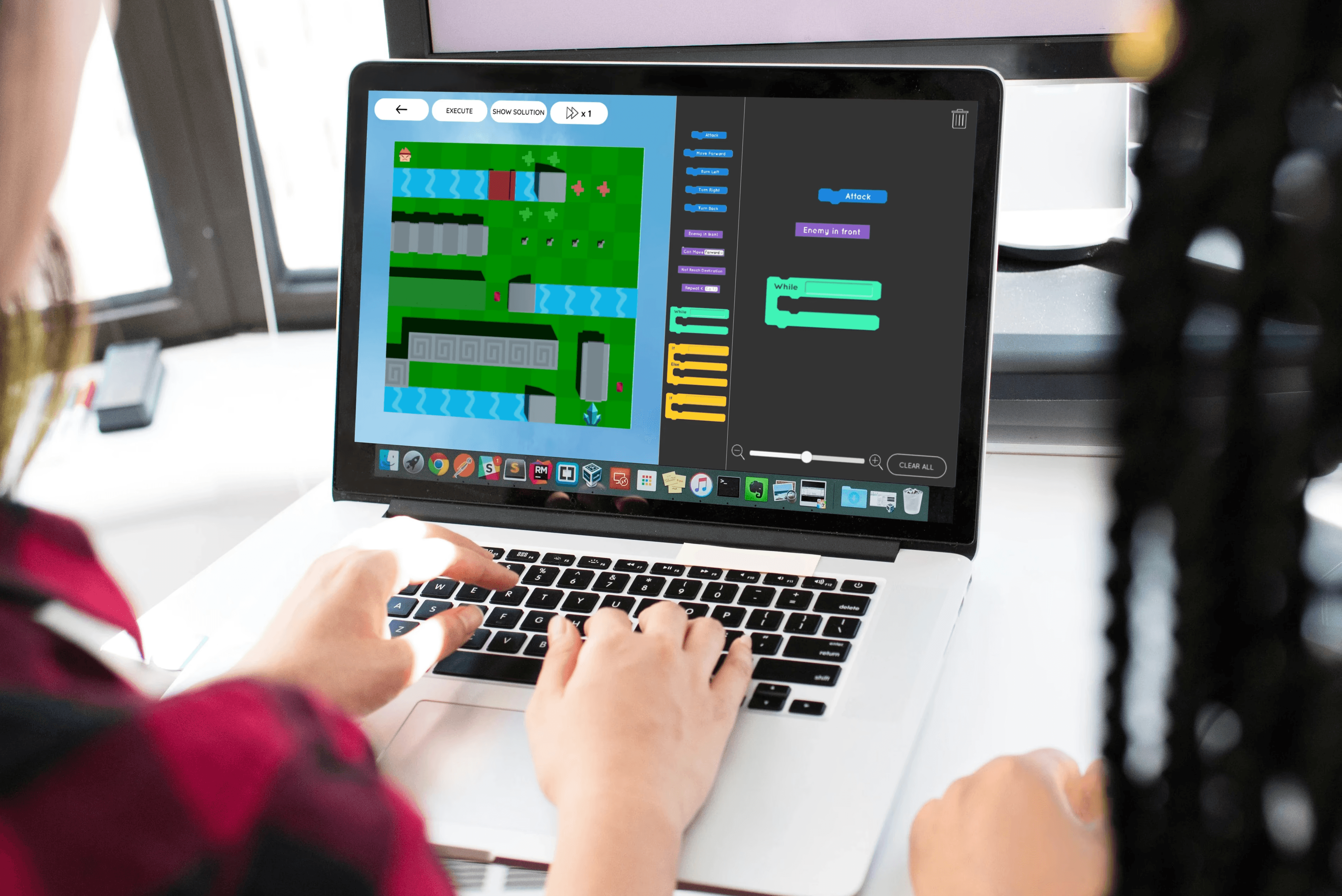
Improving adoption and engagement in a compulsory university learning platform
View other works
3D Maze
Edu-tech
Improving adoption and engagement in a compulsory university learning platform
Maze Companion
Edu-tech
Developing an adaptive AI learning companion for 3D Maze users
Maze Companion
Edu-tech
Developing an adaptive AI learning companion for 3D Maze users
TEDxNTU website
Media and entertainment
Improving the TEDxNTU website’s user experience and engagement

TEDxNTU website
Media and entertainment
Improving the TEDxNTU website’s user experience and engagement
MIDAS
Healthcare
Helping stroke patients stay motivated during therapy

MIDAS
Healthcare
Helping stroke patients stay motivated during therapy